
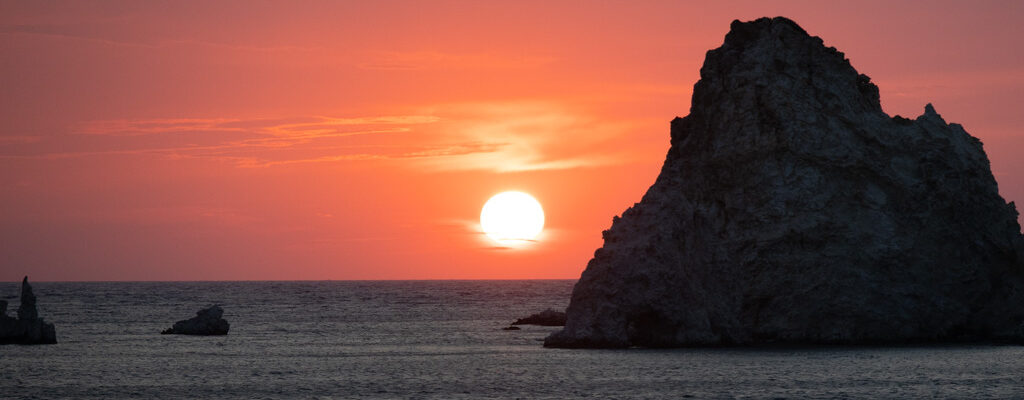
Tucked into the south-western curve of the Cyclades, Kimolos has stayed beneath most radars. Here, chalk-bright cliffs cascade into turquoise shallows, and time seems to have stood still. At first glance, Kimolos feels almost weightless—an island stripped of excess, pared down only to its essentials: rock, water, and sky.
It does not seek attention. It does not compete with its louder neighbors. Kimolos is a place that knows its beauty is revealed only to those who take the time to see it.
 Before high-speed ferries stitched the Aegean together, Kimolos floated in isolation. Families grazed goats on stony terraces, fished at dawn, and ferried blocks of chalk across the sea. Donkeys were the island’s heartbeat; and festival days unfurled to the rhythms of the tsambouna (goat-skin bagpipe). Let’s discover what makes Kimolos worth visiting.
A Landscape Forged in Fire
Kimolos takes its very name from kimolia (Greek for chalk); for centuries, islanders quarried this soft “drawing stone,” prized as a natural cleanser that travelled far beyond the Cyclades. Athletes would use this chalk to clean themselves of oil.
 Kimolos was born of volcanic activity – its land sculpted by ancient eruptions and the passage of millennia. The terrain here is gentle yet wild, with ash-colored hills, surreal rock formations, and mineral hues that shift under the sunlight.
One of Kimolos’ most captivating sights is the moonlike beach of Prassa, where the sea glows a vivid turquoise against slopes of almost blinding white stone. It’s mesmerizing.
Chorio: Where Time Moves Slowly
On Kimolos, there is “one” for everything—one road, one rhythm, one village. Unlike most Greek islands, where the principal settlement is called Chora, here it is simply Chorio (village)—a name as humble and grounded as the island itself.
But do not be misled by the simplicity. Chorio is not a village you pass through—it is a village you slowly unravel, corner by corner, step by step.
At first glance, it may seem like a sleepy maze of whitewashed homes and tangled bougainvillea, but linger a moment longer and you’ll find that Chorio is a living museum.
There is no single main square to gather in. Instead, a labyrinth of alleys leads you—almost by accident—to a series of intimate squares, each with its own character, shaded by fig trees or watched over by a tiny chapel. It is a place that does not reveal itself all at once. Chorio prefers a quiet introduction.
At the heart of the village lies the Kastro—the Medieval Castle of Kimolos and one of its most powerful relics. Built for protection during a time of piracy and peril, the Kastro is split into two parts. The Exo Kastro, or outer ring, which has been softened by time—its houses have been modernized, many now home to small boutiques, studios, and artisanal shops. But the Mesa Kastro remains partially in ruins. Today, the eastern gate leads directly to the Folklore and Maritime Museum, a small but stirring repository of island memory.
In 1638, the Kastro was attacked and set ablaze by pirates, prompting the construction of new towers. Walk its paths today, and you can still sense the urgency of that time.
 Religious architecture also flourishes in this tiny village. Kimolos, despite its size, has 80 churches. Some are grand and filled with Byzantine glory; others, the size of a single room, are kept by families and passed down through generations.
Many are closed most of the year, opened only on the saint’s feast day, when the scent of incense and homemade bread brings them back to life.
The crown jewel of Chorio is the Metropolitan Church of Panagia Odigitria. Built in 1874 as a replica of the Cathedral of Athens, its elegance feels both out of place and perfectly at home. Inside are two rare icons by the legendary hagiographer Fotis Kontoglou, along with a 15th-century icon of the Virgin Mary from the Palaeologan era—painted before the fall of Byzantium.
Eight churches on the island are considered of significant archaeological importance and protected by the Ministry of Culture. The oldest—Birth of Christ, inside the Castle—dates to 1596. The Church of Chrisostomos, the island’s former metropolis, is made from a millstone once used in gristmills.
Learn the History of Kimolos by Visiting Its Museums
Kimolos is like an open-air museum. Still, two formal museums offer a glimpse into its storied past. Across from the Panagia Odigitria, the Archaeological Museum tells the story of an island that has been inhabited since prehistoric times. Just a few steps away, inside the Kastro walls, the Folklore Museum houses heirlooms of island life—a loom, a wedding chest, fishing tools—all arranged with care and precision.
Otherworldly Beaches
 Kimolos may be small in size, but its coastline is blessed with natural splendor. From well-organized spots with soft loungers and summer tunes to hidden coves that require a little adventure, the island offers something for every kind of traveler. Whether you come with your family, a book, or simply the desire to float in peace, Kimolos has a beach that feels like it was made just for you.
Prassa Beach – White sand, turquoise waters, and a small canteen for refreshments. Ideal for families and postcard-perfect days.
Psathi Beach – Steps from the port, this sandy stretch offers easy access, shallow waters, and a relaxed beach bar atmosphere.
Bonatsa Beach – A calm bay with soft sand and minimal crowds, perfect for a long swim and a quiet escape.
Mavrospilia Beach – Raw and wild, best for sunset lovers. Reachable via dirt road; bring water, sandals, and an open heart.
Monastiria Beach – A remote beach reached by a scenic trail. Lined with trees and peaceful waters, ideal for those seeking solitude. If you continue past Monastiria over the rocks, you will come to Soufi beach, which is unorganised, shaded, and spectacularly serene.
Hiking on Kimolos
To truly know Kimolos, you must walk it. The island unveils its soul along the seven marked hiking routes that crisscross its quiet, untamed beauty, passing through thyme-scented hills, stone shepherd huts, and remote chapels. Some trails reward the traveler with a secluded beach and a cooling swim, while others lead to natural marvels, such as Skiadi, the island’s legendary stone mushroom sculpted by wind and time.
Savor Kimolian Flavors
Kimolian food is simple, soulful, and entirely of the land. Begin your day with ladenia, the island’s beloved tomato-onion pie, similar to focaccia, best enjoyed warm from the bakery before it vanishes with the morning crowd. Try Manoura, a dry cheese aged in wine sediment, or Xino, a soft, sour cheese that pairs perfectly with a fresh tomato salad. For dessert, don’t miss the braided koulouri—a bread roll shaped like an offering, traditionally made for weddings and still baked at the Paradosiakos bakery by their grandmother.
Sail to Polyaigos

No visit to Kimolos is complete without visiting Polyaigos—its wild, uninhabited twin. Just across a stretch of shimmering sea, Polyaigos (meaning “many goats”) is Greece’s largest uninhabited island. A protected Natura 2000 site, it remains untouched by time and tourism. Hire a boat from Kimolos and spend a day circling its dreamlike shores. You’ll find sea caves, natural arches glowing with refracted light, and hidden coves where silence is so pure that it feels sacred. Here, goats rule the hills, monk seals nest in secret, and the sea holds a thousand shades of blue you didn’t know existed.
Three-Island Itinerary: Combine your trip with Milos and Sifnos

If you are seeking a deeper experience in the Cyclades, Kimolos pairs beautifully with nearby Milos and Sifnos. Start in Milos, where volcanic landscapes, vivid villages, and ancient catacombs are characteristic of its elemental beauty and bold contrasts. Then cross to Kimolos, where silence becomes sanctuary, and the island’s quiet simplicity invites you to slow down and just be. Complete the experience on Sifnos, a place renowned for its authentic hospitality — known for its timeless pottery, comforting cuisine, and hiking paths that lead to whitewashed chapels under an open sky. A Cycladic harmony awaits. Book this trip today, it’s worth it.