
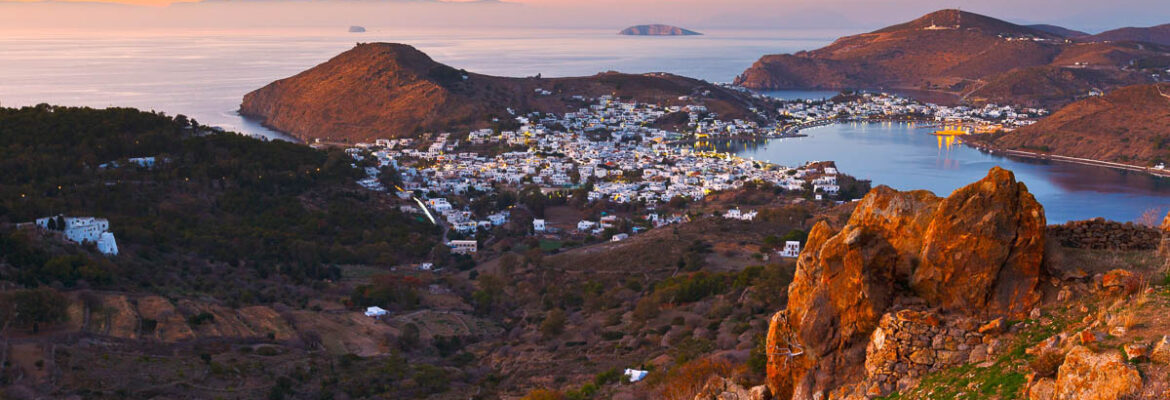
Long before Patmos became a high-profile destination in the Dodecanese, it was best known as the island where Saint John received his divine visions and wrote the Book of Revelation, also known as the Book of the Apocalypse. While Patmos remains a place of great spiritual significance, this Greek island also invites contemplation and offers a rare opportunity to bathe in its remarkable light and silence.
Once you set foot on Patmos, you realize that the silence here feels intentional, not forced. As you lay eyes on the island’s architecture and look deeper beneath the surface, cherished memories slowly unfold, layer upon layer, dating back centuries to when pirates raided its shores. Luxury here is defined by authenticity, not by lavish display, which makes Patmos even more special and beloved.
Patmos: A Sacred Landscape in the heart of the Dodecanese
In the heart of Patmos, there are three monuments of tremendous cultural and spiritual importance: the Holy Monastery of Saint John the Theologian, the Cave of the Apocalypse, and the medieval settlement of Chora of Patmos—together recognized as a UNESCO World Heritage Site.

The Book of Revelation
According to Christian tradition, it was on Patmos that Jesus Christ appeared to Saint John and instructed him to record everything he would see and experience from that moment onward. Due to his advanced age, Saint John could no longer write himself and instead dictated his visions to his devoted disciple, Prochoros.
The resulting text—the Book of Revelation—does not speak solely of religion, but of the future: from the present day until the end of the world. Written almost entirely in symbols, it remains one of the most complex and debated texts in human history. The number seven alone appears 77 times, while countless other symbols remain untranslated despite the efforts of more than 150 universities worldwide.
The Cave of the Apocalypse
The Cave of the Apocalypse is considered the second-holiest place in the world after Jerusalem, not only for Christians, but across all religions.
The Orthodox Christian tradition holds that the Creator revealed Himself to humanity three times: first on Mount Sinai, where Moses received the Ten Commandments; second in the Jordan River; and finally, here on Patmos.
The space is simple, carved into the rock, and deeply still. And inside this cave, visitors experience first-hand the exact place where Saint John slept and worshipped. However, regardless of one’s personal faith, this experience is compelling—a rare opportunity to relive history.
The Holy Monastery of Saint John the Theologian
The Holy Monastery of Saint John the Theologian crowns the highest point of Chora, rising dramatically above the island.
The imposing structure, which resembles a Byzantine fortress, was built with walls over fifteen meters high to protect the island from pirate raids. Founded in 1088 by Hosios Christodoulos, it played a crucial role in both spiritual and defensive matters in Patmos’ survival. Above the entrance, a small opening remains visible to this day—used by monks to pour hot oil or water on attackers, while bells rang across the island to warn inhabitants to seek refuge within the walls. Inside the monastery, a dedicated museum displays an exceptional collection of icons, sacred relics, manuscripts, and silver and gold-crafted objects.
Within the walls lies one of the most important monastic libraries in the Eastern Mediterranean, home to thousands of printed books, rare manuscripts, and historic documents dating back to the 11th century. The area is closed to the public and reserved exclusively for Byzantine and biblical scholars.
Chora: The Queen of the Aegean
Chora, the capital of Patmos, unfolds around the monastery’s foothill and is often described as the Queen of all Choras.
 Its remarkable Byzantine residences were among the strongest built in the Aegean, designed to protect the island from centuries of pirate attacks. Today, Chora is considered one of Europe’s most exclusive residential enclaves—defined by whitewashed houses, elegant captain’s residences, historic mansions, and a remarkable number of churches (a common sight on numerous Greek islands).
The island’s architecture speaks of resilience: gardens hidden behind stone walls, inward-facing courtyards, and narrow alleys that reward slow exploration. Getting lost here is not only encouraged—it is the only way to truly understand Chora and the intention behind its once-built form.
.
The Mansions and Windmills of Patmos
Among Chora’s most significant residences is the Simantiri Mansion, one of the oldest houses on Patmos, dating back to 1625. Still owned by Mrs. Morfousa Simantiri—the eighth-generation custodian—the mansion operates as a folklore museum. Many of the interiors were brought from Odessa, and the collection includes rare Russian icons from the 14th, 15th, and 16th centuries.
Another notable site is the Windmills of Patmos, an iconic trio that overlooks the island. Two of the windmills date back to 1588, while the third was built in 1863. The windmills were left abandoned since industrialization, until their restoration in 2010 as part of a project awarded by Europa Nostra. Their revival was made possible by Swiss banker and yachtsman Charles Pictet, who ensured these historic landmarks would endure.
Skala: The Heart of the Island
 During the 16th century, Skala of Patmos was one of the most prominent commercial ports in the Mediterranean. Lined with warehouses and ship-maintenance facilities, it played a crucial role in regional trade. Pirates would often exchange loot here, which was then used to produce and export women’s stockings and embroidery—an industry that brought prosperity to the island.
Today, Skala remains the most populated area of Patmos and its only port. It is lively yet tasteful, home to cafés, restaurants, and shops that retain a strong local character. There is a 17th-century Church of Agia Paraskevi that sits above Skala; from here, panoramic views stretch across the harbor and the surrounding landscape. It’s one of the island’s most rewarding vantage points.
Shipbuilding: A Craft Still Alive
In the Stavros area, in the south of the island, lies Tarsanas Shipyard—one of the few remaining traditional wooden boat shipyards in Greece.
Run by the Kamitsis family, Tarsanas continues a multi-generational tradition of constructing and repairing wooden boats using time-honored techniques. A visit here offers rare insight into Greece’s maritime heritage.
Beaches: A Different Kind of Luxury
Beyond its sacred and architectural wonders, Patmos offers beaches of striking simplicity and beauty.
 Psili Ammos Beach, often ranked among the island’s finest, lies in a secluded cove ten kilometers from Chora. Accessible by a short hike or by boat from Skala, it offers golden sand, crystal-clear waters, and just one taverna—nothing more is needed.
Agriolivado Beach, closer to Skala, offers calm, azure waters, white pebbles, and well-organized facilities, making it ideal for relaxing and swimming.
Kampos Beach, the most popular on the island, sits in the north with shallow waters, water sports, and a lively yet tasteful atmosphere surrounded by taverns and hotels.
Lambi Beach, known for its multicolored pebbles, is now protected—collecting stones is prohibited to preserve its natural beauty.
For those seeking seclusion, Livadi Geranou offers a remote sandy shore, sheltered from the wind, with the church of Saint George providing a postcard-perfect backdrop.
Patmos Festivals
Patmos hosts a series of vibrant festivals that reflect both its deep spiritual roots and its contemporary cultural life. The island’s most significant celebrations are religious feasts honoring its patron saints, including Saint John the Theologian on 8 May and 26 September, as well as the Dormition of the Virgin Mary on 15 August, marked by church ceremonies, local music, traditional dancing, and communal meals.
Alongside these sacred celebrations, Patmos also embraces the arts through internationally respected cultural events such as the Patmos Music Festival, dedicated to chamber and sacred music, and the Aegean Film Festival, which brings cinema and creative dialogue to the island (usually held in July).
Slow Life by Sea Around Patmos
 Exploring the small islands around Patmos by boat is an invitation to slow down. Time stretches differently here—between unhurried swims in clear waters, long lunches at simple seaside tavernas, and quiet moments spent watching the light change over the Aegean. Stops at nearby islands such as Arkoi, Lipsi, and Marathi revolve around the essentials: fresh seafood, local recipes, shaded tables by the sea, and a rhythm that follows nature rather than the clock. These are a few reasons why vacationing on Patmos is authentic, unpretentious, and deeply restorative.
Patmos: A Destination For The Select Few
Patmos is not an island for mass tourism. It is perfect for those who have already seen the world. An ideal destination for those who genuinely know how to appreciate the quiet luxury and who deeply value what this sacred place has to offer. Are you ready to discover it?