
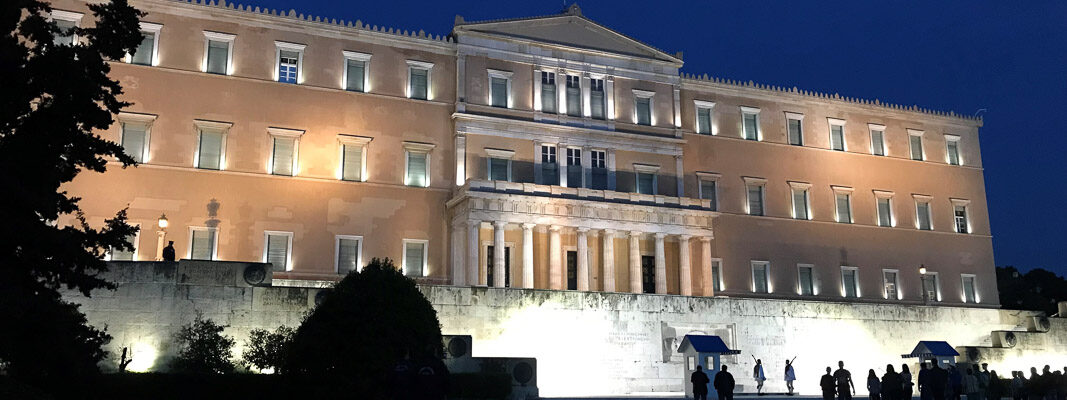
A meaningful introduction to the Greek capital begins at its very center: Syntagma Square. This is where modern-day Athens breathes in full view — where history, politics and everyday life converge. Right at the top stands the Hellenic Parliament building, one that’s impossible to overlook.
There are buildings you simply admire, and then there are those that have witnessed the birth of a nation. This one is the latter.
The Hellenic Parliament is not simply a seat of politics. First and foremost, the building served as a palace for King Otto and George I; it’s also a symbol of upheaval and rebirth — a structure carved from Pentelic marble and layered with nearly two centuries of Greek history.
Let us walk through its story.
The Birth of a State — and the Need for a Palace (1830–1862)
In 1830, Greece emerged as a modern state after the War of Independence (1821–1829). Two years later, in 1832, the Great Powers formally recognized it as an independent kingdom — a fragile yet determined nation stepping onto the European stage after centuries of Ottoman rule.
At first, the capital was Nafplio. But in 1834, Athens — still a modest town scattered among ancient ruins — was chosen as the capital of the modern Greek state.
When Greece selected Prince Otto of Bavaria as its king, the young kingdom needed more than administrative offices — it needed a residence that projected legitimacy, continuity, and identity. The authorities chose Boubounistra Hill, an elevated and central site overlooking what would later become Syntagma Square.
 The proposal came from Friedrich von Gärtner, director of the Munich Academy of Arts and architect to the Bavarian court. Alternative sites were debated — including proposals for the Acropolis itself — but Gärtner’s vision ultimately prevailed.
On February 6, 1836, workers laid the foundation stone. More than 500 people took part in the construction of the palace — members of the army, German architects, and Greek and Italian artisans working side by side. To supply the marble, they reopened the ancient quarry at Penteli, bringing to light once again the same luminous stone that had built the Parthenon centuries earlier.
Gärtner designed an austere neoclassical palace: symmetrical, restrained and dignified. Four exterior wings framed internal courtyards; broad staircases connected the floors; the building was accessible from all sides. It avoided excessive ornamentation and rather embraced the harmony of classical architecture.
By 1843, King Otto and Queen Amalia moved into their new residence. The basement served practical functions; the ground floor housed the Treasury, kitchens and a private Catholic chapel. The first floor contained the Throne Room, ballroom, reception halls and royal chambers — the most lavish spaces of the building. The upper level accommodated heirs and palace staff.
Although much of the original decoration has been lost through time, fires and transformation, fragments survive. The magnificent marble staircase still stands. The former Trophy and Aide-de-Camp rooms — today known as the Eleftherios Venizelos Hall — preserve elements of their original grandeur. There, an extensive frieze depicts scenes from the Greek Revolution, designed by Ludwig Michael von Schwanthaler in collaboration with painters Phillip and Georgios Margarites — a narrative of independence inscribed within the very walls of the palace.
In many ways, the building embodied the aspirations of the young state itself: grounded in antiquity, shaped by European influence, and determined to define a modern national identity.
The Craftsmen of Athens: Anafiotika and the Builders of a Capital
Building a capital requires hands — skilled, determined hands.
As Athens transformed into the new capital, the young state urgently sought experienced builders. Craftsmen from across Greece answered the call, including masons from the island of Anafi. These Anafiotes settled on the northeastern slopes of the Acropolis and created what we now know as Anafiotika — a Cycladic-style neighborhood they quite literally carved into the rock.

Where others saw impossible terrain, they constructed whitewashed homes that seemed to rise organically from the stone itself.
In the 1970s, authorities demolished parts of Anafiotika to create a clearer archaeological zone around the Acropolis. A small portion of the original settlement survives today — and it is absolutely worth visiting, discreetly and respectfully, as it remains a living neighborhood.
The Athens we admire today did not emerge solely from royal vision. Migrant artisans, driven by skill and opportunity, shaped it with their own hands.
From Royal Residence to Uncertain Future (1862–1922)
After Otto’s expulsion in 1862, King George I took residence in the palace.
When he arrived in 1863 — and later married Olga of Russia — he reshaped the building to suit a new royal era. The court added an Orthodox chapel to reflect the kingdom’s religious identity. Architects altered staircases and reconfigured rooms. The once compact Bavarian residence transformed into a lively royal household that welcomed foreign dignitaries and accommodated a growing family.
Two devastating fires later altered its course. In 1884, flames damaged the northern wing. In 1909, a far more destructive blaze ravaged the central section and parts of the adjoining wings. The royal family relocated temporarily to the summer residence in Tatoi. Although King George I returned to the palace in 1912, the state carried out only limited restoration work.
Greece was entering one of the most turbulent periods in its modern history. The Balkan Wars, World War I and, ultimately, the Asia Minor campaign placed enormous strain on the young state. Funds were scarce. Political divisions deepened. Architectural repair was no longer a national priority.
The building’s role as a royal residence was already weakening.
Following the assassination of King George I in 1913, his successor, Constantine I, chose not to reside permanently in the Old Palace. Instead, he used his private residence on Herodou Atticou Street — today the official residence of the President of the Republic. Queen Olga and other members of the royal family continued to occupy parts of the Old Palace intermittently, but its importance as the heart of the monarchy was fading.
Then came 1922. The royal family was permanently exiled. Queen Olga never returned to Greece. The palace, once conceived as the architectural symbol of a new kingdom, saw the last of its kings.
The Transitional Years of the Building
After the Asia Minor Disaster and the shift toward a republic, the royal family abandoned the palace. Ministries, relief organizations, and refugee services quickly moved into its halls, replacing royal banquets with urgent administrative work. Agricultural departments, health offices, the Greek Red Cross, orphanages, and laboratories all operated within its walls.
Authorities transformed the once-glorious rooms to meet the everyday needs of a struggling society. Function replaced formality.

In 1928, architect Emmanuel Lazarides designed and erected the Monument to the Unknown Soldier in front of the building, redefining its relationship with the city and permanently anchoring it to national memory. Today, the Evzones — Greece’s elite Presidential Guards — stand watch over the monument around the clock, maintaining a continuous ceremonial presence at the heart of Athens.
From Old Palace to Parliament (1929–1935)
In 1929, under the leadership of Eleftherios Venizelos, the government decided to convert the old palace into the Hellenic Parliament building.
 Architect Andreas Kriezis carried out a radical transformation. He demolished the damaged central wing and constructed a new debating chamber to accommodate parliamentary sessions. Builders added a northern entrance with six Doric columns, harmonizing with the original neoclassical design while clearly announcing the building’s new civic identity.
On July 1, 1935, Parliament held its first session in the new chamber. In doing so, Greece transformed a former royal residence into a powerful architectural expression of democracy.
Art and Modern Interventions
The building continues to evolve. Over the years, authorities and artists have erected monuments depicting pivotal moments in modern Greek history.
Inside, the Plenum Hall features the monumental bas-relief of the Battle of Pindus by Chrestos Kapralos, narrating the passage from war and occupation to resistance and reconciliation. Outside, the statues of Charilaos Trikoupis and Eleftherios Venizelos — sculpted by Yiannis Pappas — stand as enduring reminders of Greece’s political legacy.
The building has also been upgraded with modern infrastructure, including underground parking and advanced technological systems, to ensure functionality while preserving the building’s historical gravitas. The Parliament building continues to do what it has always done: adapt to the needs of its time.
From Royal Grounds to the National Garden
No palace is complete without its gardens.

What was once known as the Royal Garden — created under the devoted supervision of Queen Amalia in the 1840s — later became the National Garden, a green sanctuary at the very heart of Athens. Designed by French horticulturist François Louis Bareaud, the garden was envisioned not merely as decoration, but as a living extension of the palace.
Today, the National Garden stretches across 24 hectares beside Parliament and the Zappeion Hall, home to thousands of trees and plant species from Greece and around the world. Beneath its shaded pathways lie Roman mosaics; around its lakes glide ducks; Athenians walk, read, jog and pause under eucalyptus and palm trees planted more than a century ago under the supervision of Queen Amalia herself.

Importantly, the National Garden is also a member of the European Route of Historic Gardens, a cultural route recognized by the Council of Europe. This distinction places it among some of the continent’s most significant historic landscapes — not simply as an urban park, but as a heritage site of European importance.
A Living Monument
Few buildings in Europe embody such a visible evolution from a Palace of a Bavarian king to a refugee administration center to a museum and, finally, a parliament building. And when you stand in Syntagma Square and look up at its pale marble façade, you are not merely seeing a building. You are seeing the architectural autobiography of modern Greece.