
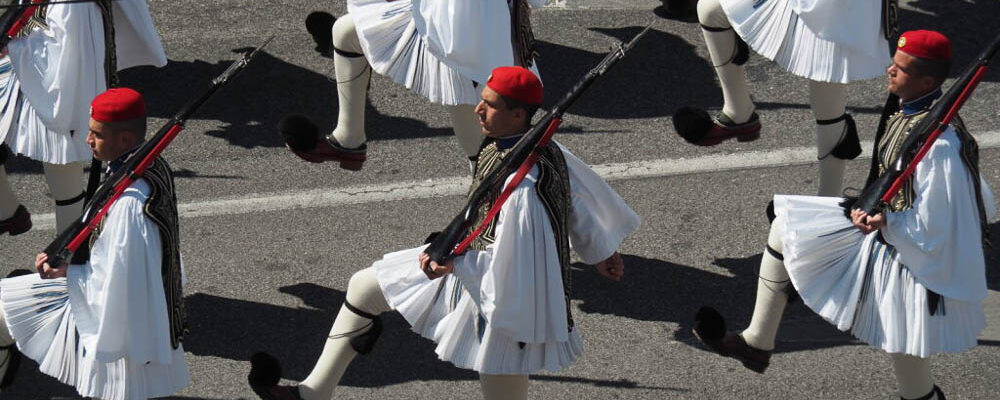
If you’ve wandered through central Athens, passing the Hellenic Parliament in Syntagma Square, it’s really a one-in-a-million chance that you will miss the two figures standing in perfect stillness, guarding the Tomb of the Unknown Soldier.
At any time of day or night, regardless of the weather, they stand there for something far greater than a ceremony.
They are the Evzones — Greece’s elite presidential guards.
However, the Evzones are not simply ceremonial guards — they are living symbols of Greece’s endurance and discipline. They must at all times remain postured, silent and impossibly composed, unless otherwise instructed.
Trying to make an Evzone smile or react will elicit no response. And that is precisely the point.
A Legacy of The Evzones
The term “Evzone” dates back to ancient times and appears in Homeric texts to describe elite warriors. But the official presidential guard as we know it today began in 1867, when infantry regiments were formed to protect the young Greek state.
The courage these young men showed during the Balkan Wars and both World Wars elevated them to almost godlike status in the Greek imagination. After World War II, as the armed forces modernized, most regiments were dissolved. One unit remained in Athens — not for battle, but for memory.
 Today, the Evzones guard the Tomb of the Unknown Soldier 24 hours a day. They also stand watch at the Presidential Palace, raise the Greek flag at the Acropolis every Sunday at sunrise, and lower it at sunset. They accompany the President on official visits abroad and represent Greece in national parades — including New York City’s annual Greek Independence Day parade, where their presence brings visible emotion to the Greek diaspora.
How The Evzones Are Chosen
Serving as an Evzone is regarded as one of the highest ceremonial honors in Greece. These soldiers are carefully selected during their mandatory military service. Height is not optional — candidates must be at least 1.87 meters tall. Physical strength, symmetry, and posture are essential.
Their training lasts five intense weeks. Nearly half of the candidates fail.
 Stillness becomes an art form. Any form of expression must disappear. At their post, they are required to stand completely motionless for an hour at a time. Every fifteen minutes, they subtly shift position, and every hour, the official change of guard unfolds with deliberate, almost theatrical precision.
Communication while on duty is forbidden. A regular army soldier stands discreetly nearby. In the rare case of an emergency, the Evzone may strike the butt of his rifle against the ground. Questions are answered not with words, but with blinks: once for yes, twice for no, three times for uncertainty.
Even their pairing is intentional. Each Evzone is matched with a “brother,” often similar in appearance. They dress together, stand guard together, and serve as one. If one cannot perform his duty, the other does not stand with anyone else.
The Marching is A Ritual
Watching the changing of the guard is truly unlike witnessing any other ceremonial ritual in the world. The march is slow and deliberate.
 Each step is lifted high — leg extended straight, rising to shoulder height before descending in controlled precision. The rhythm is uneven yet synchronized. It resembles a dance.
The ceremony takes place every hour in front of the Parliament building in Syntagma Square. On Sundays at 11:00 a.m., the Grand Change unfolds: the full guard marches from their barracks accompanied by a military band.
The Story of the Uniform
The Evzone uniform is not a costume. It is a carefully executed story.
Each element carries symbolism rooted in Greece’s struggle for independence and identity. Every piece is handmade — some taking months to complete.
Foustanella
The iconic white pleated skirt is crafted from approximately 30 meters of cotton and contains 400 pleats — symbolizing the 400 years of Ottoman occupation. Blue and white braiding reflects the Greek flag.
Fermeli
The intricately embroidered waistcoat can take up to six months to complete. Each design is unique, reflecting traditional folk artistry.
Farion
The red cap with its long black tassel represents sacrifice and mourning.
Ypodetes
The white shirt with its voluminous sleeves symbolizes the purity of the national struggle.
Doulamas
A long tunic worn in winter (navy blue) and summer (khaki), adapting tradition to the season.
Tsarouchia
The red leather shoes with black pom-poms are perhaps the most recognizable feature. Each shoe weighs around 1.5 kilos and contains dozens of nails hammered into the sole. The sharp, rhythmic sound created as they strike the ground is symbolic — a reminder that Greece stands alive and free.
Dressing for duty can take up to one hour. Every fold must be precise and every line immaculate.
A Powerful Way to Connect With Greek Culture
 It is one of the most photographed rituals in Athens, and it’s free to witness. But witnessing the changing of the guard should not be merely treated as something to check off a list. It is a meditation on discipline. When you stand in Syntagma Square and hear the sharp echo of tsarouchia against marble, pause for a moment. We recommend that you look beyond the choreography and really pause to take in the silence. It’s a powerful experience and a true way to connect with the soul of Greece.