
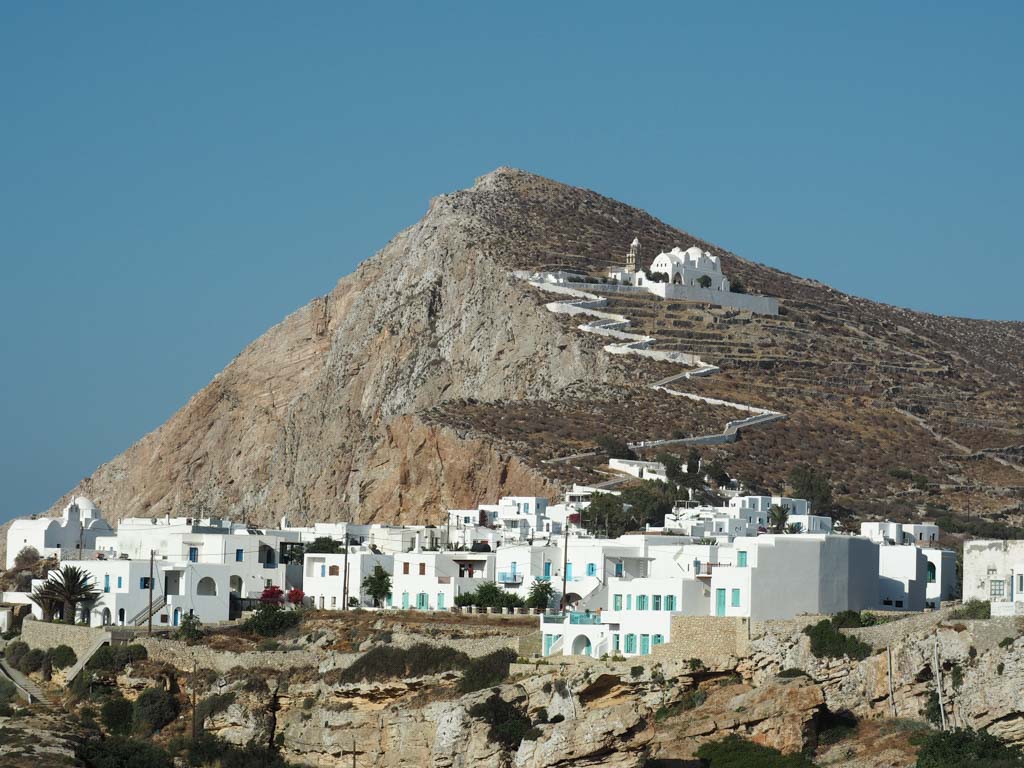
If Santorini had a little sister, that would be Folegandros — yet quieter and more reserved, but equally mesmerizing. Located in the southern Cyclades, between Milos and Santorini, and nearby Sikinos, this small island embodies everything one dreams of in a Greek escape. The unspoiled landscapes with their rugged terrain, dotted with whitewashed houses hugged by lush bougainvillea, and an authenticity that seems to have gracefully escaped mass tourism. Folegandros is one of those places where time lingers like a soft sea breeze and where simplicity is the most incredible luxury of all.
How Folegandros Got Its Name
The origins of Folegandros are quite layered, just like its landscape. Folegandros was the son of the mythical King Minos of Crete; that’s how the island got its name (he had led the first settlers here).In ancient times, it was part of the Minoan sea routes that connected Crete with the rest of the Aegean world. Over the centuries, it was home to Cretans, Carians, and Dorians. They each left their faint traces, which one can encounter in the island’s architecture and folklore to this day. Unlike its glamorous siblings, Folegandros remained humble.

The earliest written mention of Folegandros dates back to 425 BC, found inscribed on a marble stele on the Acropolis of Athens. Another reference appears in a Delphic inscription from the 4th–3rd century BC.
The geographer Strabo (1st century AD) described Folegandros as “σιδηρεί” — the “iron island” — referring to its rough, unyielding terrain. The ancient poet Aratus, too, wrote of its rugged nature. These descriptions defined Folegandros as a place of resilience — shaped by nature’s force and human endurance.
Its Chora, one must note, is one of the most beautiful in the Cyclades. Set dramatically on a cliff 200 meters above the sea, it’s composed of a labyrinth of cobbled alleys, flowered courtyards, and charming squares shaded by tamarisk trees. Walking through it feels like stepping into a painting; it truly does.
The Landscape: Rugged Beauty of the Cyclades
Folegandros’ landscape is both austere and poetic. The island is only 13 kilometers long, yet, for an island of its relatively small size, its terrain is varied. You will find cascading cliffs that lead to hidden coves and stunning golden beaches. Terraced hills serve as a gentle reminder of centuries of hard labor and devotion; their stone walls trace the history of cultivation.

The island’s highest point, Mount Agios Eleftherios, rewards hikers with sweeping views of the Aegean — a sight so vast it seems to blend earth and heaven. Here, nature reigns quietly — the hum of cicadas, the scent of wild thyme, the distant sound of goats’ bells. A beauty one must feel with their presence.
The “Little Santorini” Spirit
Folegandros is often called the little Santorini, not for its crowds or nightlife, but for its dramatic and charming landscape. Like Santorini, it offers that spectacular merge of cliffs and sea, but without the bustle. The sunsets from Panagia Church, which crowns the hill above Chora, are breathtaking. A sacred moment when the sky ignites in gold and rose, and the island seems to stand still for a little while.

The island’s magic lies in the subtle: in a conversation with a local fisherman, in a lemon tree growing wild beside a white wall, in the taste of homemade rakomelo (raki with honey) under the stars. It doesn’t get more authentic than that.
The Lemon Houses and Island Traditions
Folegandros has quite remarkably managed to preserve its rural heritage through its lemon houses. These small stone huts, scattered across the terraces, were traditionally built to protect citrus trees from the fierce northern winds. They were once essential to daily life. Nowadays, these humble shelters are cherished symbols of the island’s deep harmony with nature.

You will find that locals still tend to their gardens, weave baskets, and make cheese using age-old methods. The pace of life here moves gently, dictated by the sun and the sea, as it always has. Folegandros moves at a rhythm that invites visitors to slow down, breathe, and rediscover the beauty of simplicity.
A True Taste of Folegandros: Matsata
For a true taste of the island’s cuisine, you must try matsata, its signature dish. This handmade pasta, prepared with flour, eggs, and water, is traditionally served with slow-cooked meat — usually rooster, rabbit, or goat — simmered in either a rich tomato or lemon sauce infused with local herbs. Each family has its own recipe, often passed down through generations, and each plate carries the essence of the island’s home-cooked hospitality.
Pair it with a glass of local rakomelo or white wine from the Cyclades, and you’ll understand that Folegandros’ beauty doesn’t just lie in its views but also in its flavors.
An Authentic Greek island experience

Folegandros is an island ideal for those seeking authenticity. It invites you to wander and to reconnect with what truly matters. Folegandros is celebrated for its simplicity. Come and experience it for yourselves.