
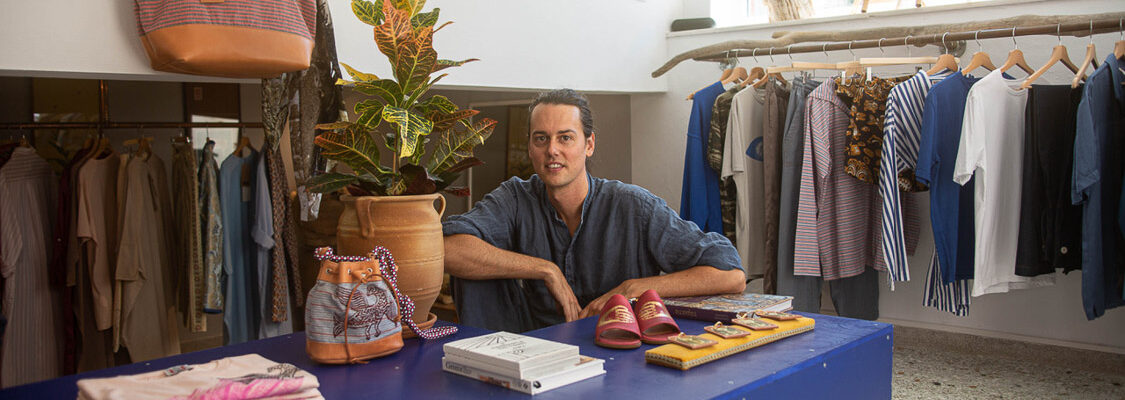
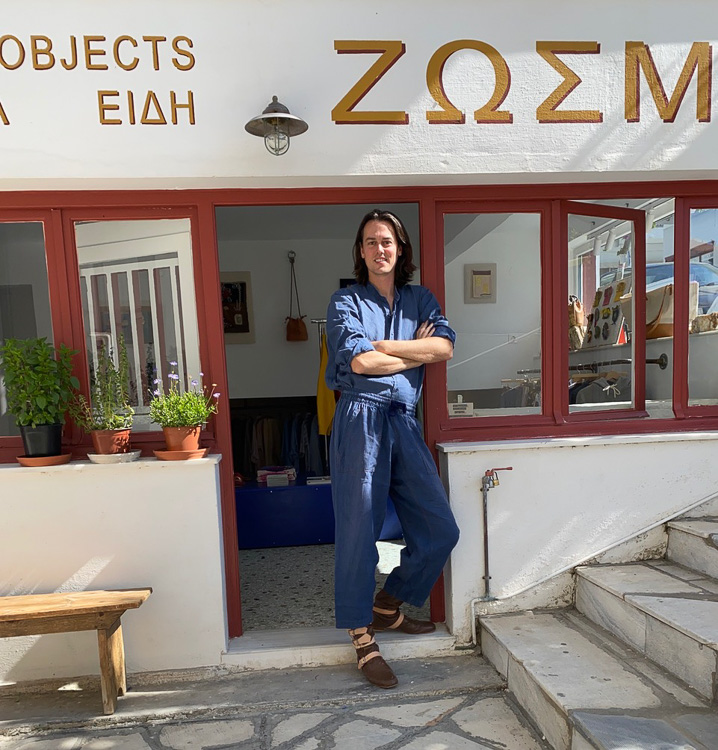
Theo Anastasato is a designer and textile artist whose creative world brings together international fashion, Greek heritage and an unmistakable sense of humor. From studying at Central Saint Martins and working with the legendary Vivienne Westwood to establishing his own creative path in the Cyclades, Theo has never been afraid to question conventions and follow his curiosity. As the creative force behind Intellectual Leisure, a clothing brand with a story behind every piece, and Zosma, a distinctive little shop in Tinos where fashion, art and carefully chosen objects come together, he invites us to look beyond appearances and discover the stories woven into the things we surround ourselves with.
He recently sat down with Fly Me To The Moon for this Artistic Tales interview to reflect on his journey, his fascination with Greek identity, the meaning behind Intellectual Leisure and his exploration of traditional textile techniques. From the stories carried by ancient tamata to his latest creative experiments inspired by the scents and flavors of island life, Theo reminds us that creativity is not simply about making things — it is about remaining curious, finding meaning and allowing every experience to become part of the story.
FMTTM: You have lived and worked between very different worlds — New York, Austria, London, Tokyo, Spain and Greece — and your career has taken you from Central Saint Martins and Vivienne Westwood to your own creative practice. Looking back, when did you begin to feel that you weren’t simply designing clothes, but were searching for your own visual language?
TA: I strive for independence, I believe. I remember making that decision: I want a job (as opposed to I want to do my own thing), when I was at college. I was horrified by the stress that would mean. Then, after internships and working in different places (let’s not forget I was at Zara Home too, a very commercial environment), I realized there is only this one solution, I have to do my own thing. I don’t have to do it as per the examples I had seen in those college years, I thought it was perfectly fine doing it my way, even if it means struggling for a bit. And I did slowly find out what doing it my way meant, simply by doing it. I think Vivienne Westwood was an inspiration to me regarding that decision, somehow. But also the fact that I am really not that easy to employ and just did not get that lucky with my work environments.
FMTTM: You have described the desire to trace the materials you work with back to their origins and to rediscover techniques through your own hands. What changed in your creative life when you began working more closely with traditional crafts, natural materials, weaving and dyeing?
TA: Working in the fashion industry can also be a total desk job. Very mundane, actually, with some bursts of faffing around with fabrics. But there is also commuting in a city of commuters, drawing black little lines on a screen for hours and sending polite follow-up emails to collaborators halfway around the globe. At one point I just got really interested in material in a very basic and naive way, with an atavistic longing to trace things back to their origin. Find more meaning for it and value. The soil the fibers grew in or the animal they grew from, or what nanotube they were squeezed out of. It came very naturally to me to also
want that time or luxury to be able to say, that’s what I will do now: just trace it all the way back and use my hands again more. Covid and lockdown must have played a role too; these feelings were probably a quite common phenomenon.
 FMTTM: Your work often plays with Greek heritage, religious imagery, folklore and even Greek stereotypes, but with a sense of humor. What does “Greek identity” mean to you today — especially as someone who grew up between different cultures?
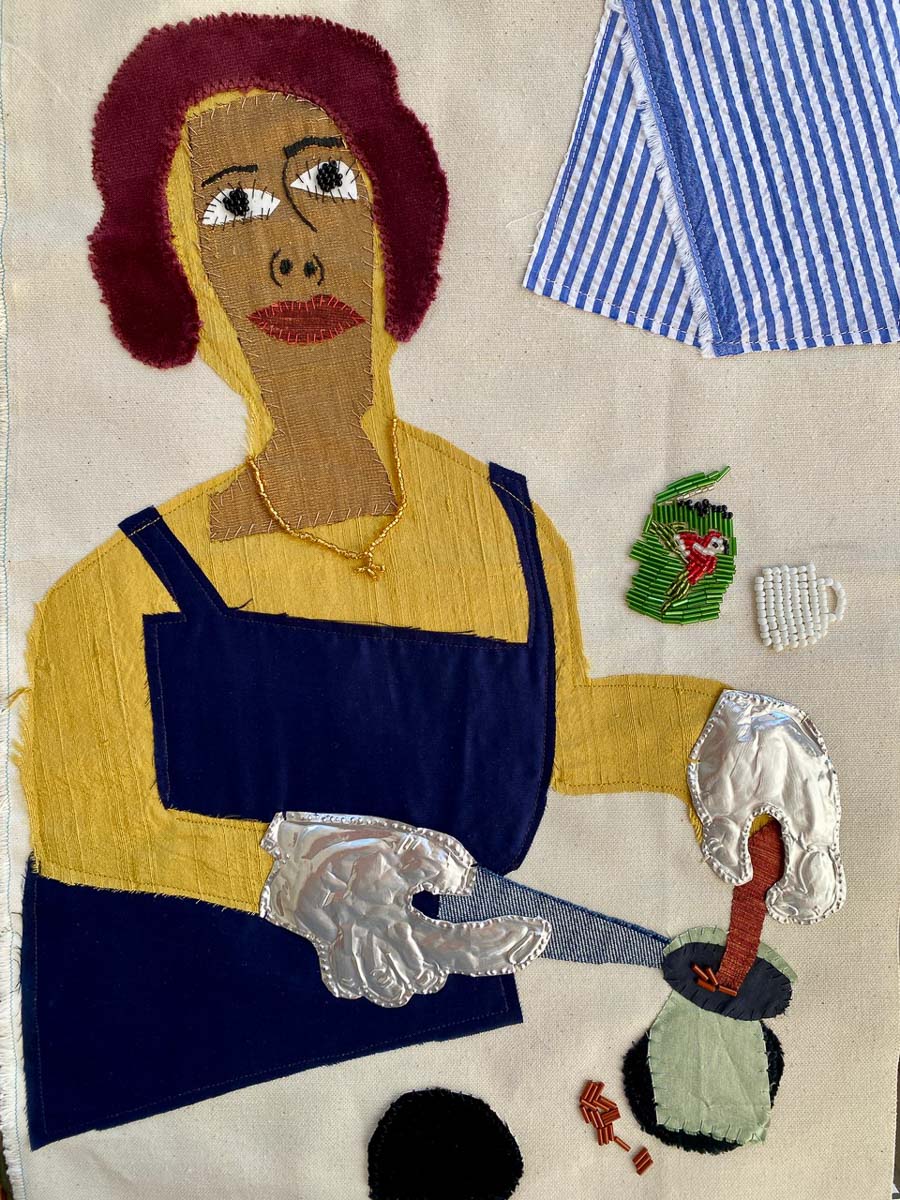
TA: Oh gosh, huge question. Greek identity is a daily experience when you are in my shoes: someone who grew up without it but still feels related to it. Thank God I have this fascination with it all and the eagerness to suck it all in and deal with it on an emotional level, too. So I have this luxury of just discovery, curiosity, bewilderment and excitement. Sometimes I feel like a 19th-century anthropologist. I also ALWAYS add that I am half Greek when I get asked where I come from. Like I have to prove something! So Greek identity is so many things: the cult of the male and battle cry of the woman, the constructed attachment to Hellenism, Christianity, tourism, family protocol… the superstition! I mean, if you look at painters like Tsarouhis and Fasianos, you get some of the gist, and then you also get miracles like Melina Mercouri in Stella or a song by Marinella. It’s endless, really.
 FMTTM: Intellectual Leisure is described not only as a clothing brand but as a state of mind, and your collections don’t necessarily follow the traditional fashion calendar. What does “intellectual leisure” mean to you personally, and has that idea changed as your life has moved closer to the islands and to a slower, more hands-on way of creating?
TA: That sounds very grand – it is definitely a state of mind, if not a cult! I always like to look smart when I quote Immanuel Kant: Sapere Aude! – dare to think. Only I would maybe turn it into Sapere Gaude! – enjoy to think. Now, in the context of my clothes, that means there is a story behind every piece, and I can tell it to you there in the shop. I mean, to shop like that is a very intellectual pastime, I’d say! Also, there is this joke on resort wear and mass tourism.
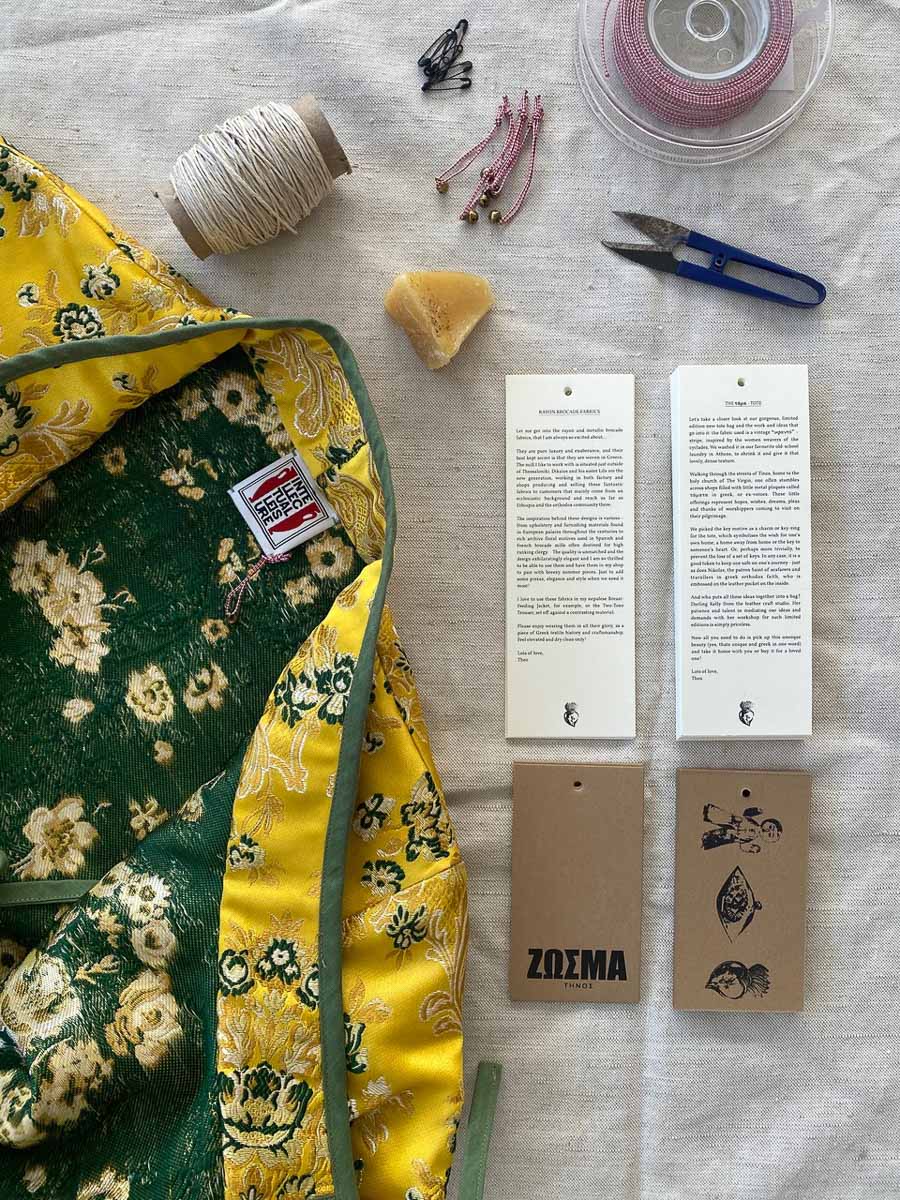 Like all the luxury brands with their own stores in Mykonos that sell you some crazy expensive Mykonos special edition of their brand when it’s all really the same everywhere. I mean it’s fabulous but also totally nuts. So I guess the brand is saying use your brains and have fun doing so. Regarding your second question, well, the island definitely feeds into my thinking and inspiration processes and is just so so beautiful, but I am not sure if it moves me to slower creating. That’s just me, I create kinda slowly and depend on slow people.
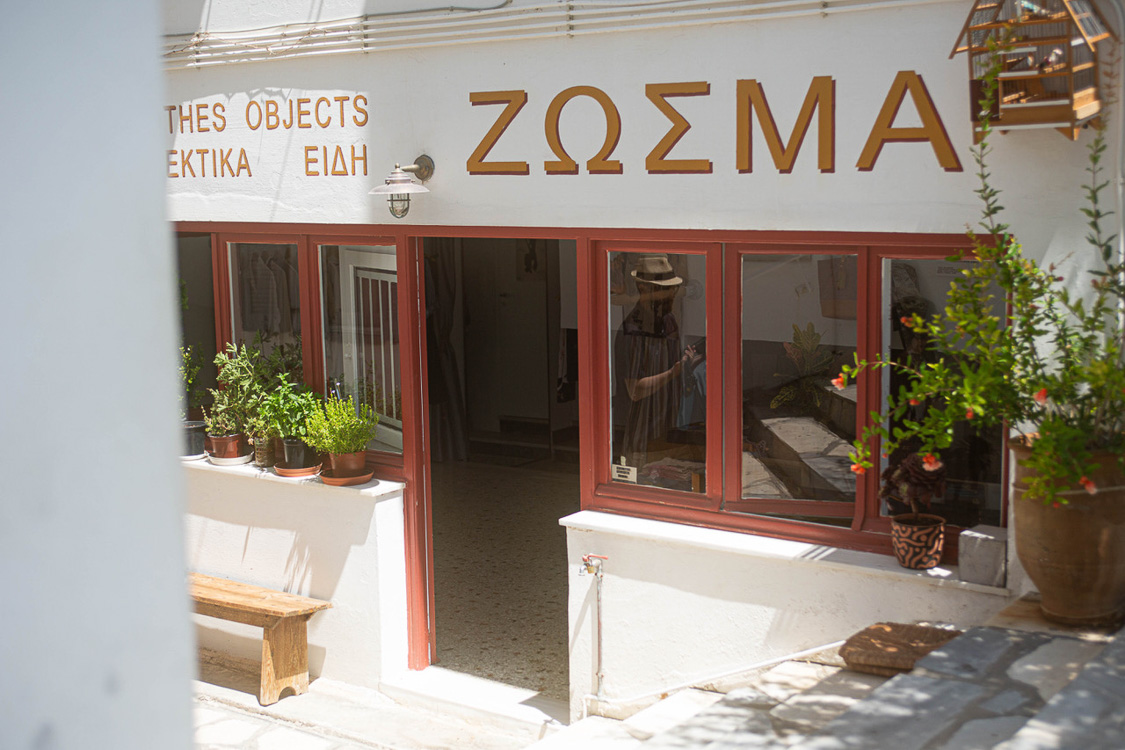
FMTTM: Zosma feels less like a conventional shop and more like a little universe — somewhere fashion, art, objects, memory, and curiosity can coexist. When you choose something to bring into Zosma, what makes you stop and think, “This belongs here”?
TA: Most things in there are what I made in one way or another, with the help of great people. There has been a control element to that but also one of independence and economic reasoning. I have started, however, to take on pieces from other designers and I have also been lucky to have been approached by interesting people. A piece speaks to me when I think it’s fabulous, because maybe it has humor or another layer to it and is the right colors. It’s interesting that I work with people of Greek heritage with mixed backgrounds too; I just realized, because we obviously have things in common.
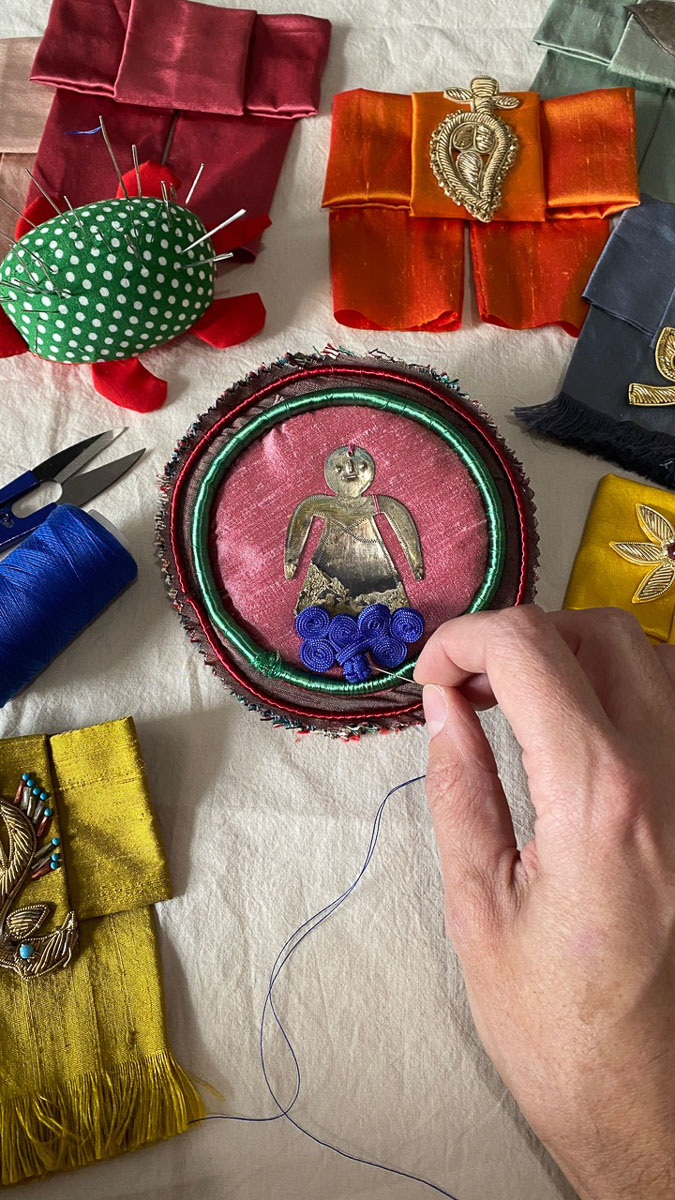
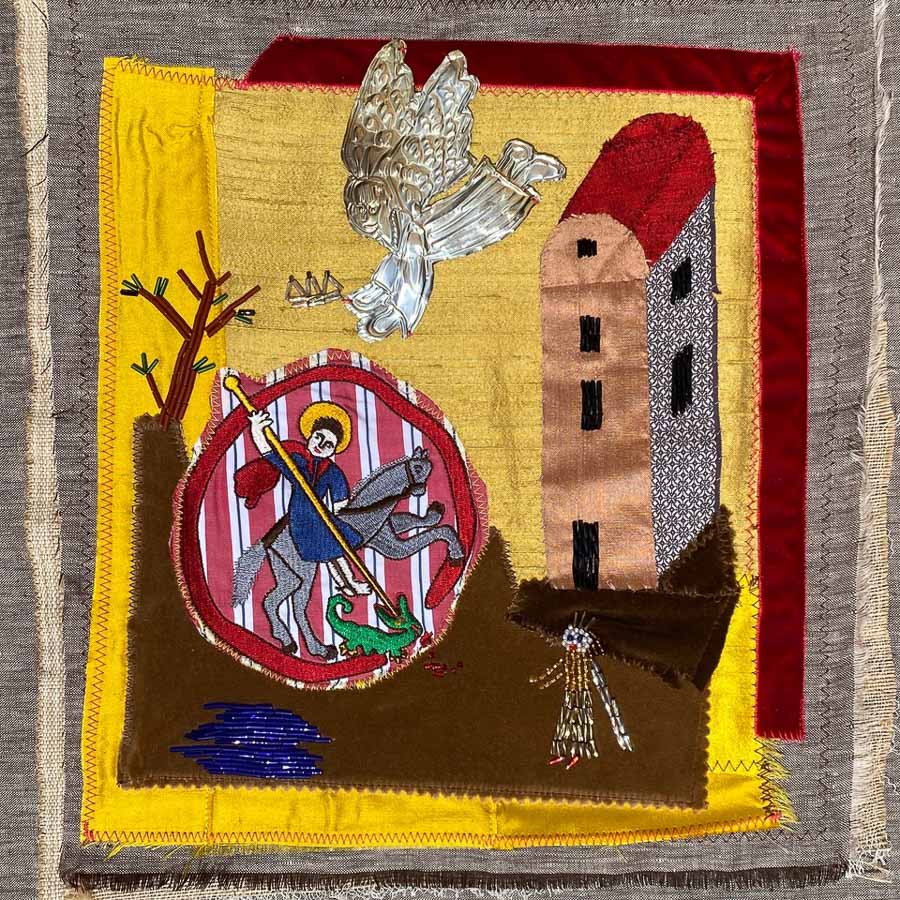
FMTTM: Your work with tamata brings together something deeply traditional — the votive offering — with textiles, embroidery, beads and contemporary art. What fascinates you about taking an object that already carries people’s hopes, prayers and stories and giving it another life through your own hands?
TA: I work with different types of tamata, or afieromata: antique ones, contemporary ones stamped into metal that I provide the maker with, or self-made ones from thin metal sheets, like little drawings in metal. They all have their own context that they contribute to the creation of each piece. The old ones come loaded and become real protagonists in a scene; the modern ones are used like a medium in their own way, and the self-made ones provide a much more personalized approach to the subject. What really fascinates me is the expression – of hope, despair, gratitude. The idea of offering and veneration. I just want to be a link in the chain of it all.
 FMTTM: After everything you have experienced in fashion, from international houses to your own brands and now your life and work in the Cyclades, what are you still curious about? Is there something you haven’t made yet, haven’t learned yet, or a creative direction you feel is still waiting for you?
TA: This sounds so cliché, but I am really into scents and flavors. Like I am dying to make a soap for the floor and an ointment of some sort for the body. I am also working on a vermouth recipe and one for a sweet liqueur, both based on smells of and moments on the island. Aneighbour’s garden of potted plants with the inside of a church, for example. So there’s that – know any potential collaborators?
FMTTM: Many years ago, you said that your great goal was balance and happiness. Looking at your life and work today, what does that word — balance — mean to you now?
TA: Balance has actually become more of a unification process. At the time I meant something quite mundane: work/life balance. As an employee, that separation was modus vivendi – you’re in one place a certain, rather large amount of time, and then you have time off. The two don’t touch. Now it has all become one. My life is my work: wherever I am, I suck things in and they become output somewhere else, eventually. That doesn’t mean I’m working
without a break. It means everything is tied together in one big twine of individual strands: my art, my travels, my relationships, my practice, running a small business, all of it. And it’s not finished – I keep adding strands and pulling others out as life throws things at me. All of that gives me immense pleasure and satisfaction.
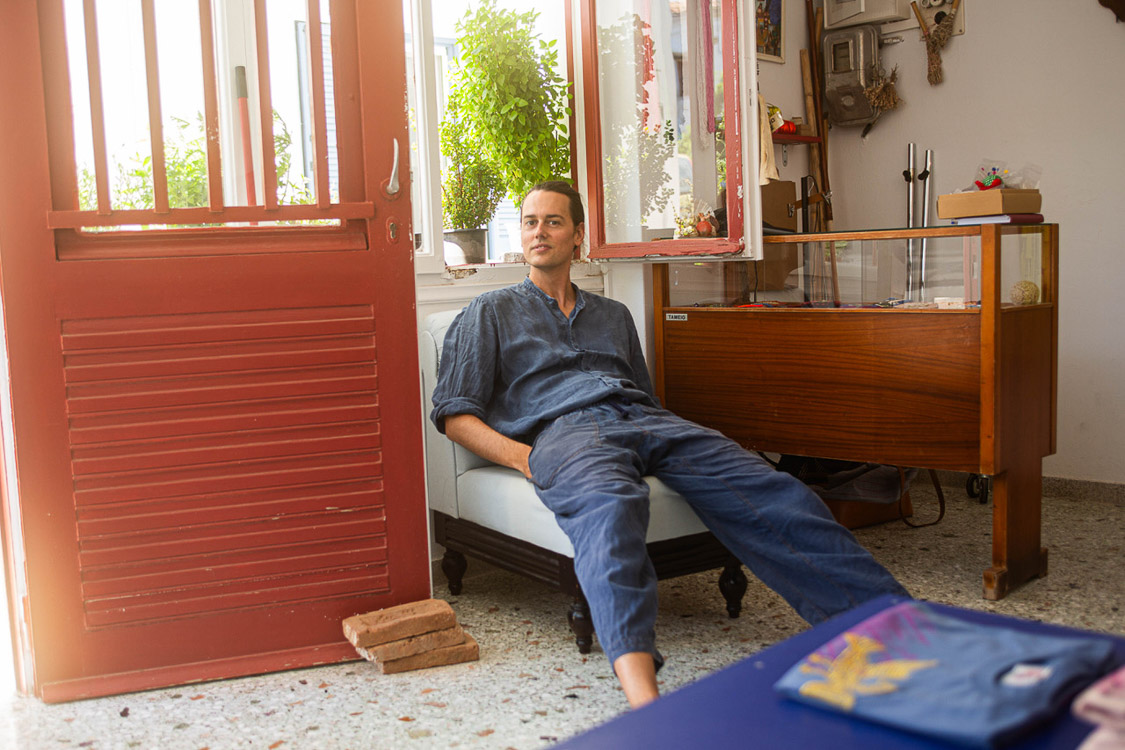 To learn more about Theo’s work, visit and follow his Instagram account