
As you slowly start to descend the hillside above Trypiti on Milos’s northern side, the familiar sounds of the Aegean begin to fade. The scorching summer sun gives way to cool shadows, the cicadas’ song softens, and the white volcanic rock closes in around you. Ahead, a series of small arched doorways leads into the darkness of one of Greece’s most extraordinary historical monuments: the Catacombs of Milos.
It is a remarkable introduction to an island that has always had more to tell than its mesmerizing coastline suggests.
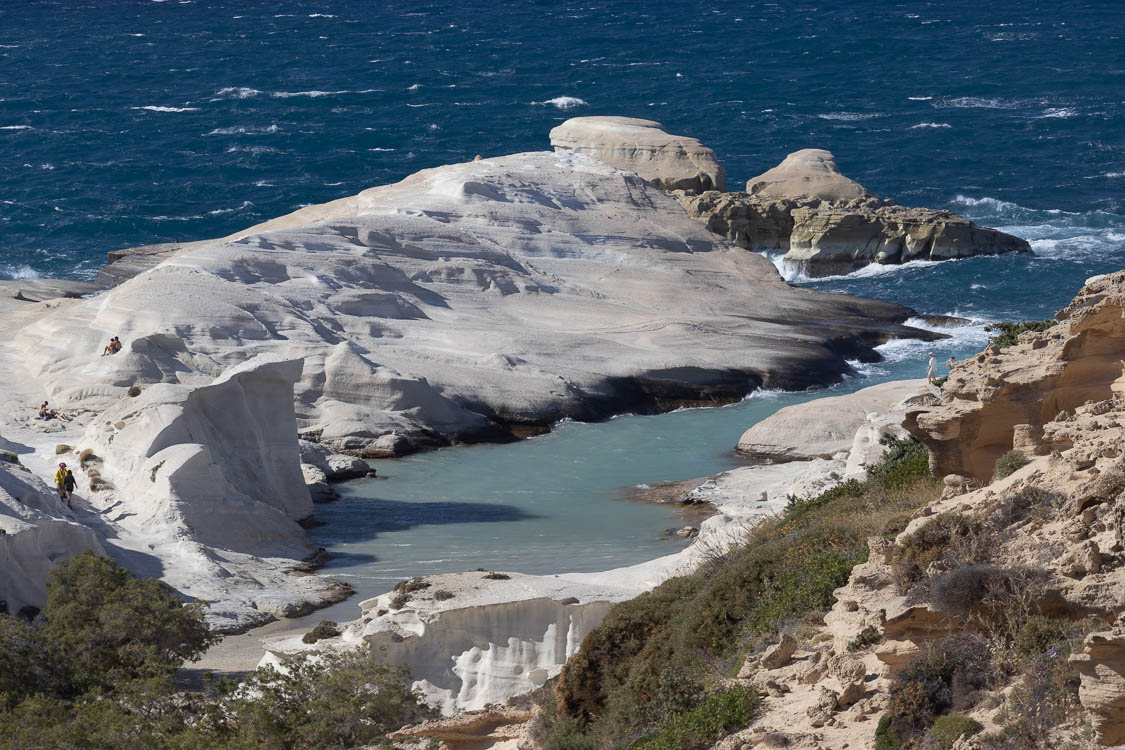 Set in the southwestern Cyclades, Milos is shaped by volcanic forces that have given it one of the Aegean’s most extraordinary landscapes. At Sarakiniko, the wind and waves have sculpted the pale volcanic rock into an otherworldly landscape of smooth curves and sculpted hollows. Standing here, surrounded by brilliant white formations and the deep blue sea, you could easily picture yourself on another planet.
At Kleftiko, towering white cliffs rise dramatically from the water, concealing caves and natural arches that were once associated with pirates. Along other stretches of coastline, the earth reveals its volcanic origins in shades of rust, ochre and sulfur yellow, while warm springs emerge beside the sea.
Yet Milos is so much more than its extraordinary geology.
This is the island where the famous Venus de Milo was discovered in 1820, where prehistoric traders mined obsidian and carried its precious volcanic glass across the Aegean, and where an early Christian community created one of the Mediterranean’s most important catacomb complexes.
It is also an island with a culinary identity all its own, where centuries-old traditions survive in family kitchens, local dairies and recipes that celebrate the ingredients of this marvelous land.
The Island Born of Fire
To best understand Milos, start by looking beneath your feet. The island’s volcanic past has shaped almost everything about it: its dramatic coastline, its mineral-rich landscape and, perhaps most importantly, its history.
Long before tourism brought visitors to its shores, Milos was a prominent center of the prehistoric obsidian trade. Obsidian, a naturally occurring volcanic glass with a dark, glossy surface, can be sharpened to an extraordinary edge. Its value in prehistoric times was considerable, and as such Milos became one of the Aegean’s principal sources of this material.
Thousands of years ago obsidian traveled from the ancient settlement of Phylakopi across the islands and as far as Minoan Crete, helping establish Milos as an important trading center.
Throughout history, the island’s mineral wealth continued to attract attention. Sulfur, manganese, and other valuable minerals were extracted from the island’s landscape, leaving behind fascinating industrial remains.

At the Milos Mining Museum in Adamas, visitors can discover more about the island’s impressive geological heritage. The museum’s collections offer a wealth of insight into the island’s mineral resources, mining traditions, and the people whose lives were shaped by the earth.
But perhaps the most extraordinary transformation of Milos’s volcanic landscape took place underground.
The Early Christian World
The Catacombs of Milos are hidden beneath the hillside near Trypiti. This extraordinary network of underground galleries dates from approximately the 1st to the 5th centuries AD.
Often compared with those of Rome, the catacombs are among Greece’s most important early Christian monuments.
The complex consists of three main galleries, now connected by passages opened during later archaeological work. Inside, the walls reveal rows of carved burial niches known as arcosolia, some of which accommodated entire families.
A walk through these narrow galleries offers a rather intimate experience. You won’t encounter grand columns or elaborate decorations. Instead, the significance lies in the place’s simplicity and the people who created it.
Just imagine a small Christian community gathering here as the new faith spread throughout the Roman world. These galleries became places of burial, remembrance and worship, preserving evidence of a community that existed almost two thousand years ago.
The catacombs were discovered in 1840, although looting had already disturbed many of their original contents. Their historical importance, however, remains immense.
In 2009, the Church of Greece declared Milos a sacred island, by recognizing the exceptional significance of its early Christian heritage.
It is difficult to imagine a more striking contrast with the island’s sun-drenched beaches. Yet this is precisely what makes Milos so fascinating.
A Front-Row Seat to Ancient History
From the underground galleries, the journey continues towards one of the island’s most beautiful historical settings.
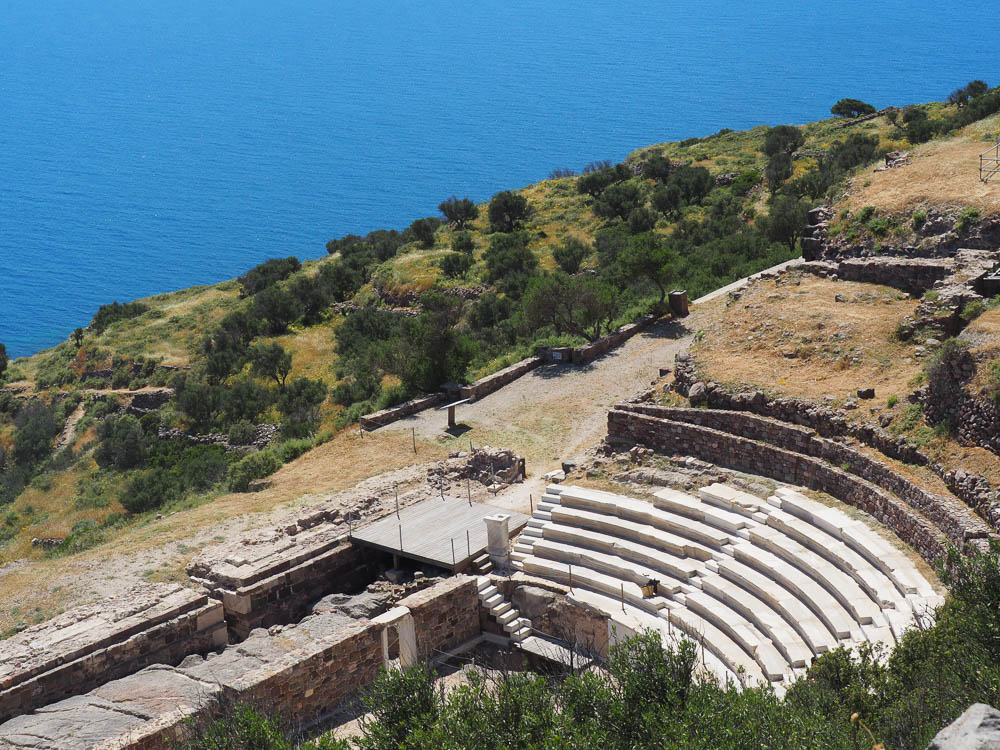
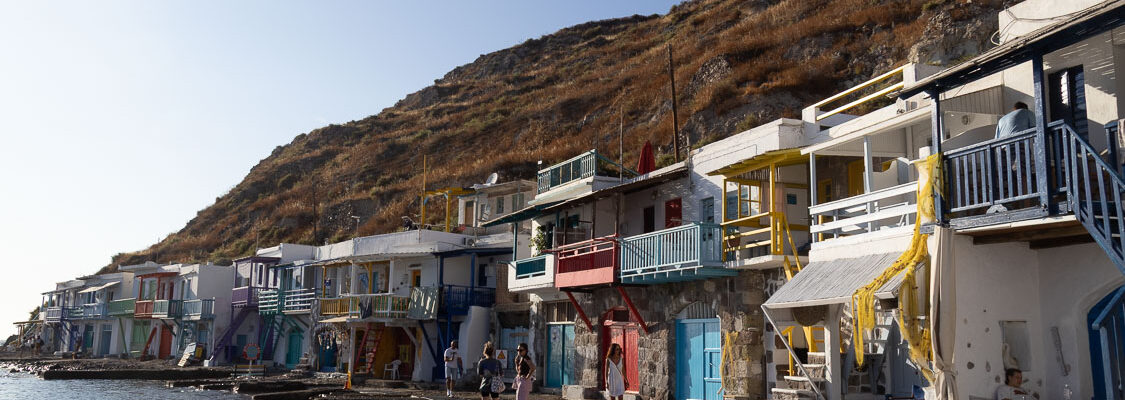
The Ancient Theatre of Milos sits on a hillside overlooking the Gulf of Milos, with the little picturesque fishing village of Klima visible below (another part of the island worth visiting). Its marble seating rises in graceful tiers, facing a spectacular natural backdrop.
The theatre is Roman in its present form and is among the best-preserved ancient theatres in the Cyclades. It stands close to the remains of the ancient city of Melos, a settlement with a history stretching back many centuries.
This landscape witnessed one of the most dramatic episodes in ancient Greek history. In 416 BC, during the Peloponnesian War, Athens attacked the island of Melos after its inhabitants refused to abandon their neutrality and join the Athenian side.
The Athenians eventually captured the island, executed its adult men and enslaved its women and children. The episode became famous through Thucydides’ account of the Melian Dialogue, one of the most powerful discussions of political power, justice and the realities of war ever written.
There is another remarkable connection to this very landscape. In 1820, a farmer working near the ancient city discovered a marble statue of Aphrodite. The sculpture, now celebrated worldwide as the Venus de Milo, eventually found a home at the Louvre in Paris, where it remains one of the museum’s most famous treasures.

Admission to the ancient theatre is free, making it one of those rare places where you can enjoy extraordinary history without an entrance ticket. The best time to visit is late afternoon, when the light softens across the gulf and the marble begins to glow.
Explore its coastline
While Milos’s history takes you underground, its coastline invites you to experience another world entirely.
At Papafragas, near Pollonia, nature has created one of the island’s most extraordinary swimming spots.
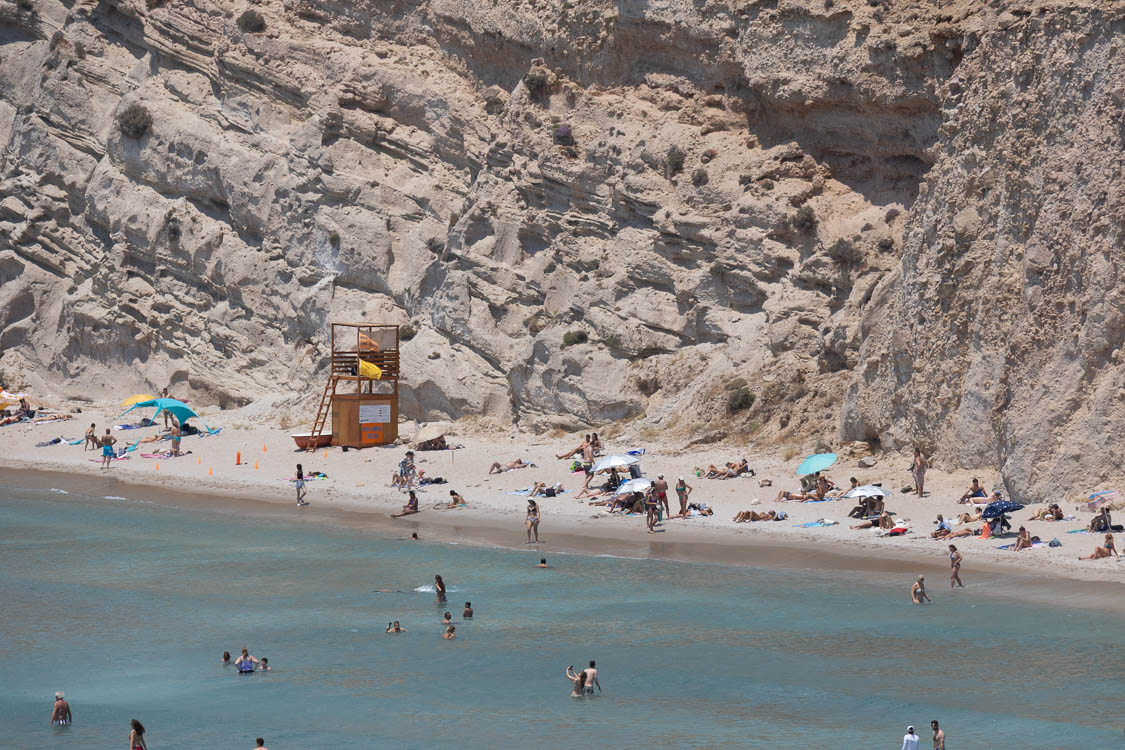 From the roadside, the landscape initially appears quite unassuming. But as you walk toward the cliff edge, the view suddenly opens onto a narrow canyon carved through pale volcanic rock.
Follow a series of steps down to the water, where a sheltered channel of astonishingly clear sea winds between the cliffs. At the far end, a natural arch frames the open Aegean like a perfectly composed photograph.
If you look closely, you can still see the marks of old carved mooring points in the rock. It is here that small boats once sought shelter.
Papafragas isn’t an organized beach, so come prepared. Visit early, wear shoes with a good grip and bring your own water. The descent can be challenging, so always check sea conditions before swimming.
For something more relaxed, head to Plathiena, a spectacular bay on the northern coast just below Plaka. With pale sand and shallow turquoise water, shaded by tamarisk trees, it creates a relaxing setting.
In the afternoon, head up to Plaka, the island’s charming capital. Wander through its narrow whitewashed lanes, discover little shops and traditional houses, and continue towards the Kastro, the old fortified settlement associated with the Venetian Sanudo family in the 13th century.
From the hilltop, the views stretch across the Aegean. Watching the sunset here is especially rewarding as nearby islands become silhouettes against a fiery sky painted in shades of gold and pink.
The Pirates’ Sea: Discovering Milos by Boat
You can only truly appreciate another side of Milos from the water.
The island’s coastline is full of hidden coves, sea caves, natural arches and dramatic rock formations, many of which are inaccessible by road. A boat excursion is therefore one of the most exciting ways to experience the island.
A full-day cruise around Milos usually takes you past some of its most spectacular coastal landmarks.

One highlight without a doubt is Kleftiko, a breathtaking collection of white volcanic cliffs and sea caves rising from exceptionally clear water.
Its name translates as ‘thieves’ or ‘bandits’, describing the area’s association with pirates who once used its secluded coves as hiding places.
The sailing route also takes you past Sarakiniko, offering a completely different perspective on its extraordinary white rock formations, and the abandoned sulfur mining installations at Paliorema, where rust-colored industrial remains create a fascinating contrast against the blue sea.
 Beyond Milos lies Polyaigos, the largest uninhabited island in the Cyclades, administratively part of neighboring Kimolos.
Its name means ‘many goats’, and its landscape remains wonderfully wild, with goats among its few inhabitants. The island is surrounded by exceptionally clear water, secluded beaches and spectacular sea caves.
Polyaigos is an important habitat for the Mediterranean monk seal, one of the world’s rarest marine mammals. Its protected natural environment makes it particularly precious.
Discovering Milos Through Its Food
Every Greek island has its own culinary personality, and Milos is proud of its own.
On Milos, one of the most distinctive flavors is beltes, a rich, concentrated tomato preparation that captures the essence of the island’s summer.
 The paste is made using local bournela tomatoes. After peeling and seeding, they are salted and placed in traditional earthenware dishes under the summer sun. Over several days, the tomatoes are stirred patiently as the moisture evaporates, and the mixture thickens into an intensely flavored paste.
Of course, much of the credit goes to the island’s volcanic soil, which is often associated with the tomatoes’ distinctive flavor.
Spread a little beltes over warm bread or a traditional rusk, add some local olive oil and enjoy it alongside a small glass of souma, the island’s traditional grape-based spirit.
There is much more to discover, of course. Look out for Mileiko, a local aged cheese often compared to Parmesan, and skotyrokolokytha, delicious courgette fritters prepared with soft local skotiri cheese.
The island’s traditional cooking also includes sun-dried fish grilled over embers, capers gathered from the rocky landscape, tomato fritters, pumpkin pies with raisins and honey, slow-cooked rooster, and dishes prepared in traditional clay pots.
One of the best places to experience this culinary heritage is Oh! Hamos, on Papikinou Beach in Adamas.
The name means ‘chaos’, but the atmosphere is wonderfully welcoming. Tables sit close to the sea, and the restaurant celebrates the family’s own agricultural and culinary traditions, including home-produced meat, cheeses and freshly prepared dishes. The menu is full of local flavors, with generous portions and recipes that perfectly reflect the island’s food culture.
What Stays With You
It is easy to understand why travelers fall in love with Milos. Milos is an island of extraordinary contrasts. Fire and water, ancient history and modern island life, dramatic landscapes, and, of course, life’s simple pleasures. And perhaps that is its greatest attraction. Milos is an island that honors its stories, waiting for curious travelers to discover them.