
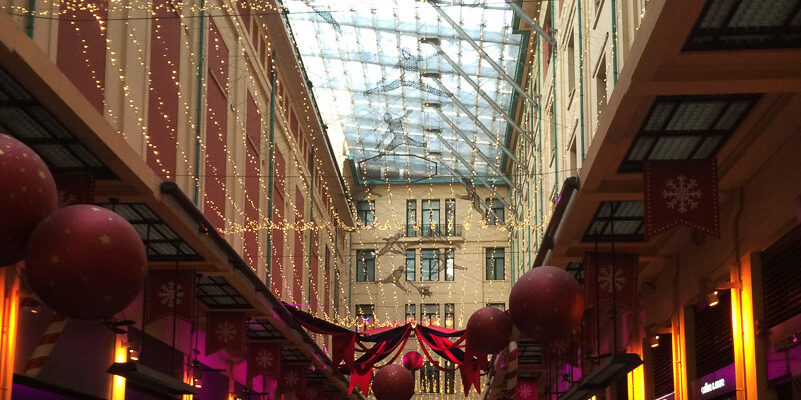
In Greece, you can discover some of the most revealing city walks not on the grand avenues, but just beside them. Once you step off the main street and pass through a discreet entrance, it’s like you’ve suddenly entered a different world. Marble staircases rise around you, old shop signs catch your eye, and a sense of fading glamour lingers in the air. In Athens and Thessaloniki, the stoa — the covered arcade or galleria — is more than a shortcut. But rather a fragment of the city’s memory.
To understand these spaces, you have to look back far beyond the modern city. The role of stoas in ancient Greece was not defined solely by their architecture; they served as everyday living spaces. These long covered colonnades brought citizens together – to exchange ideas, observe, trade and engage in casual small talk. The reconstructed Stoa of Attalos in the Ancient Agora is a wonderful reminder of its origins — a space where architecture fostered human connection.

Some stoas were born as elegant commercial passages. Others became cultural addresses, collectors’ corners, food landmarks, or nearly forgotten urban stages which are now finding a second life. Their names often carry the story of the people, institutions, or families that shaped them. What remains today is a fascinating mix of architecture, memory, and reinvention. Let’s take a look at some of the most interesting stoas in Athens and Thessaloniki.
The most interesting stoas in Athens
Stoa Nikoloudi
Few stoas in central Athens feel as quietly refined as Stoa Nikoloudi, the elegant passage linking Panepistimiou with Stadiou. It takes its name from the architect Alexandros Nikoloudis, whose vision for the site dates back to 1897, when he was still a student in France. What started as an idea for a small arcade with shops and a glass roof gradually evolved alongside the city itself.
By 1918, the building was turned into a multi-use complex, and in 1936, the stoa took its final form as a fully realized commercial passage. Influenced by the École des Beaux-Arts and inspired by the great arcades of London, Nikoloudis introduced a more eclectic architectural language that moved beyond strict Athenian neoclassicism.
Today, following careful restoration, it continues to carry a polished yet understated character. Its mix of long-standing shops and newer additions reflects a quiet continuity — a place where old Athens still functions, rather than simply being remembered.
Stoa Emporon
Stoa Emporon connects Voulis Street with Lekka and draws its name from the Merchants’ Fund building that once housed it. Architects Leonidas Bonis and Emmanouil Lazaridis designed it in 1950, shaping a passage defined by two levels linked by a striking double marble staircase — a dramatic architectural gesture for what was once an everyday commercial space.

Its golden decades were the 1960s, 1970s and 1980s, when the arcade thrived alongside the city’s growing retail culture. Later, after the Merchants’ Fund moved away and shops began to close, the stoa slipped into decline. Fortunately, this is not the end of the story. In recent years, Stoa Emporon became associated with regeneration efforts and the revival of vintage neon signage, giving it a new afterlife as one of the most atmospheric retro passages in Athens.
Stoa Orfanidou
If one arcade captures the social energy of postwar consumer desire, it is Stoa Orfanidou. This passage became legendary because Athenians once queued there to buy some of the first jeans sold in the city — a powerful symbol at a time when denim represented style, modernity and a glimpse of America.
Today, the character has shifted. Instead of being defined only by fashion, Stoa Orfanidou has become a haven for collectors, with shops dealing in antiques, stamps, coins and engravings. There is something wonderfully specific about that transformation: a place once associated with youth culture and the excitement of the new now attracts people seeking rarity, history, and tangible fragments of the past.
Stoa Arsakeiou
Stoa Arsakeiou, set inside the Arsakeio Megaron, belongs to a larger, grander Athenian story. The complex occupies an entire city block between Panepistimiou, Arsaki, Stadiou and Pesmazoglou, and the arcade itself dates to 1907. Historically, it housed bookshops and jewellers, and became part of the city’s social and cultural life for generations.
Its modern revival is particularly compelling because it is not simply a restoration but a rethinking of what an urban arcade can be. The current concept mixes gastronomy, Greek artisanal products, culture and education. It is currently in its final stages of development.
Stoa tou Vivliou
Closely linked to the Arsakeio complex, Stoa tou Vivliou deserves its own place in the story because it became far more than a retail arcade. The Philological Society founded it and positioned it as a space that actively shaped the intellectual life of Athens through education and culture, rooted in the idea of the book and everything that grows around it — lectures, thought, conversation, and public learning.
Its Free University gave the arcade a special identity, attracting academics, writers, artists and curious citizens. That is part of what makes Athens stoas so rich: one may be remembered for jeans, another for merchants, another for books and ideas. The stoa was never just about shopping; it was also about the formation of urban communities.
The most interesting stoas in Thessaloniki
Agora Modiano
In Thessaloniki, no arcade-like market tells a more layered story than Agora Modiano. Its history is inseparable from the city’s modern past. After the devastating fire of 1917, engineer Eli Modiano and architect J. Oliphant designed the market on the site where the Talmud Torah Synagogue had stood, as part of the redesign envisioned in the Hebrard Plan. When it opened, it became the city’s first traditional food market and one of its largest indoor markets.

From the beginning, Modiano was closely tied to both the Jewish community and Thessaloniki’s commercial life, housing some of the city’s best shops and products. Later, it declined, with many of its 144 shops abandoned, before being restored and reintroduced as a next-generation food market. The market is undergoing renovations and is closed until further notice.
Stoa Saoul
Stoa Saoul takes its name from Saoul Modiano, the prominent Jewish banker who built the commercial arcade between 1867 and 1871. It once formed part of the so-called “Cité Saül,” functioning as a small commercial city within Thessaloniki. Within this network of passages and interconnected streets, the arcade linked key thoroughfares and hosted offices, trade and financial activity.
The site represents the Modiano family’s broader influence, which extends beyond commerce. Architect Eli Modiano maintained offices there, alongside the Modiano Land Bank. After the devastating fire of 1917, the city redesigned its urban fabric, and in 19,29 it rebuilt the arcade, shaping it into the form it largely retains today. Stoa Saoul remains especially evocative because it preserves the memory of Thessaloniki as a cosmopolitan mercantile city, shaped by Jewish entrepreneurship, finance, and urban ambition.
Stoa Malakopi
Stoa Malakopi, in the Valoritou area, is one of Thessaloniki’s most atmospheric passages. The building was constructed in 1906, in what had once been a central part of the city’s Frankish quarter, and housed the Bank of Thessaloniki, established by the Allatini family. The plans are associated with architect Vitaliano Poselli, whose work helped shape much of Thessaloniki’s architectural image.
Its most haunting detail is the clock on the façade, said to have stopped at the moment of the 1978 earthquake. That single image has helped define the stoa’s character ever since. Later, after changes in ownership and use, the passage was renamed Malakopi.
Why stoas still matter

What makes these stoas memorable is not just their beauty, nor only their age. The fact is that each one gathered a distinct crowd and followed a unique rhythm.
Next time you walk through Athens or Thessaloniki, allow yourself to wander a little differently. Look for the passages and don’t just follow the map, because the best discoveries happen unexpectedly.