
You hear them before you see them.
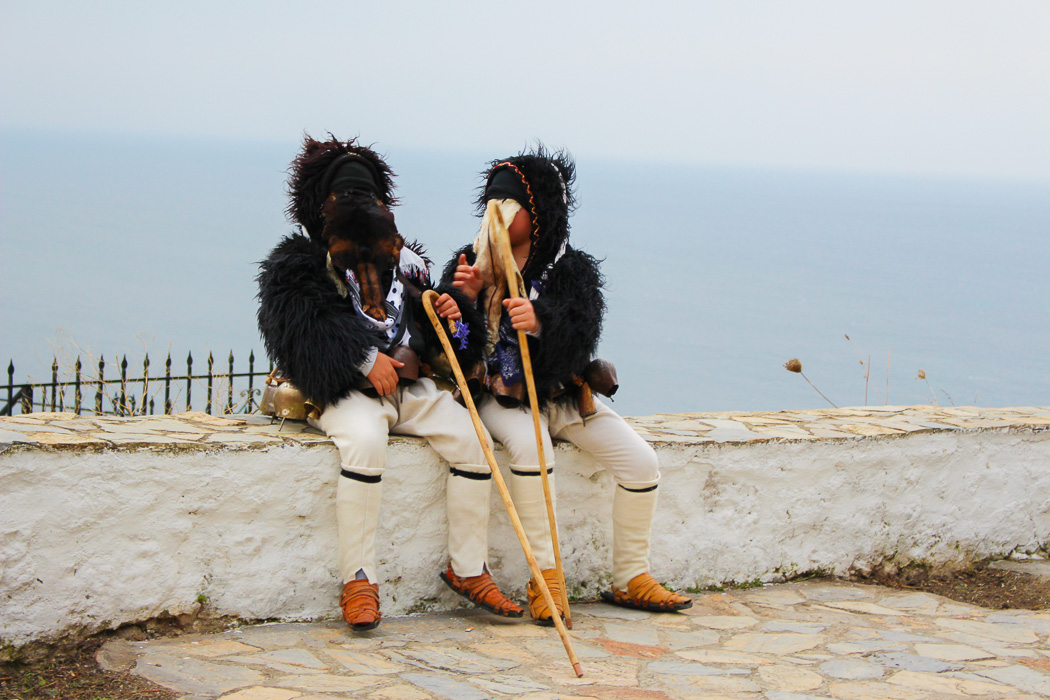
On a weekend in the run-up to Lent, somewhere below the castle in Skyros Chora, a low clanging rolls up the hill through the tangle of whitewashed alleys: heavy, uneven, unmistakably rhythmic. It grows. Then a figure turns the corner in a shaggy black cape, his face hidden behind a hanging goatskin, a great belt of bells slung around his waist, swinging a shepherd’s crook as he goes. Behind him, light on her feet, a veiled figure in white and yellow waves a handkerchief, clearing the way.
 This is not a performance staged for visitors. It is the Skyros Carnival, in which the geros, the korela, the Frankos (a comic figure dressed in trousers and a jacket, his face covered with a mask) and the satirical trata revive customs that many trace back to ancient Dionysian rites (it takes place on the last Sunday before Lent). It is the clearest clue to what makes this island unlike anywhere else in the Sporades.
Skyros is the southernmost island of the Sporades and the largest, at roughly 209 square kilometers, yet it sits well apart from the rest of the group. Skiathos, Skopelos and Alonissos form a tight chain off the coast of Magnesia, linked by hydrofoils from Volos.
Skyros lies alone to the south-east, some 80 kilometers beyond Alonissos and about 36 kilometers off the coast of Evia. There is no ferry from Athens: you can reach Kymi on Evia’s eastern shore by car and cross from there, or fly into the island’s small airport. Its architecture and the sharp contrasts of its landscape bring it closer, in spirit, to the Cyclades than to its northern neighbors.
Its history disappears into deep time. The heroes of myth passed through: Achilles, hidden on the island as a boy, and Theseus, who met his end here (pushed off the cliff by the local king, Lycomedes). So did real conquerors who left their mark, among them the Ottoman admiral and pirate Barbarossa.
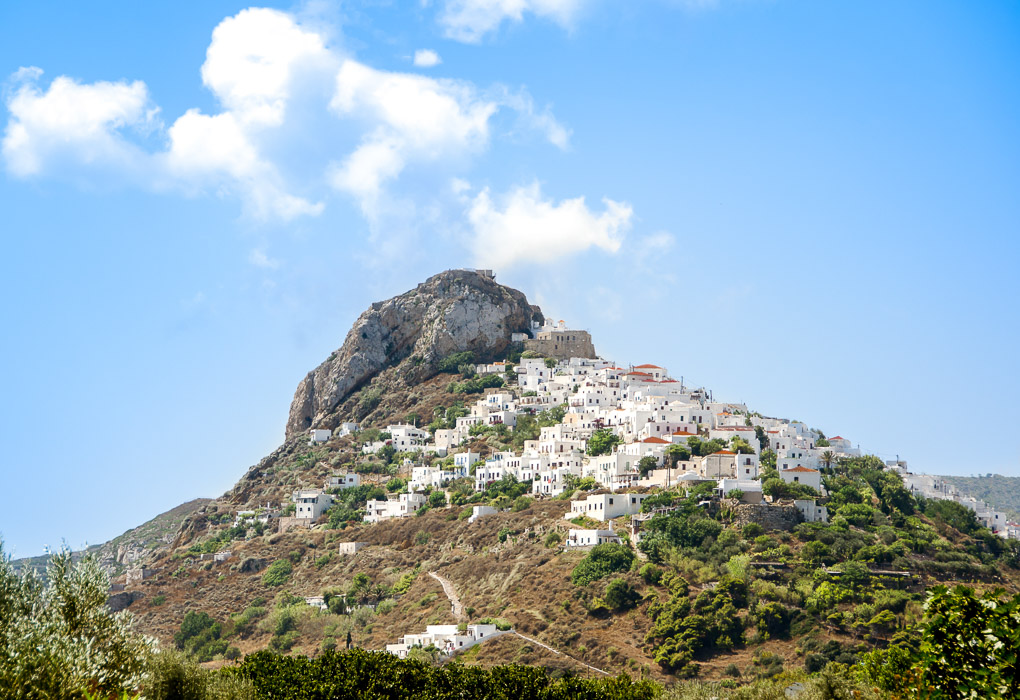
Chora, the island’s capital, is built like an amphitheater around its Byzantine castle, a Cycladic-style village of raised sleeping platforms called sofades and domed chimneys studded with plates, and some of the finest beaches in Greece lie beyond it.
Skiathos has its sixty-odd beaches and its nightlife. Skopelos has its Mamma Mia film locations. Skyros remains the least touched by mass tourism of them all, home to only about three thousand people, roughly nine in ten of them in Chora. Skyros has bells.
The land itself is divided: dense pine forest and green fields in the north, a dry, wild and waterless south where Mount Kochylas, the island’s highest peak, is home to small Skyrian horses that live free, a rare native breed found wild nowhere else. The old ways survive in customs that time has barely touched and in crafts that never died out: woodcarving, pottery, embroidery and weaving. Painted plates and copper cover the walls of the old houses, and carpenters still carve small wooden chairs with geometric patterns.
Between living traditions, sharp contrasts of landscape, and an authenticity hard to find elsewhere, Skyros offers a beauty that makes no effort to impress, and a calm to match. To understand why the island still rings the way it does, you first need to understand the island.
Two Islands in One
Look closer, and the divide is starker still. Draw a line across the island’s narrow waist and you find two entirely different worlds.
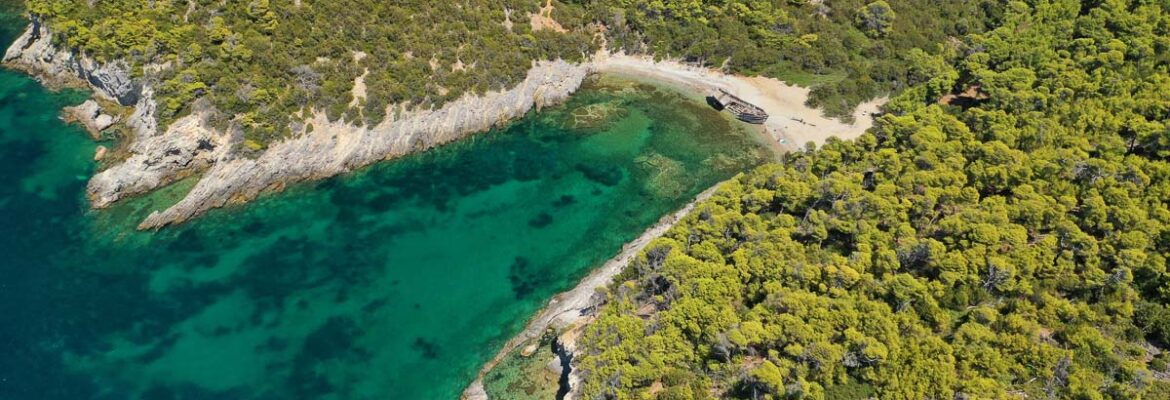
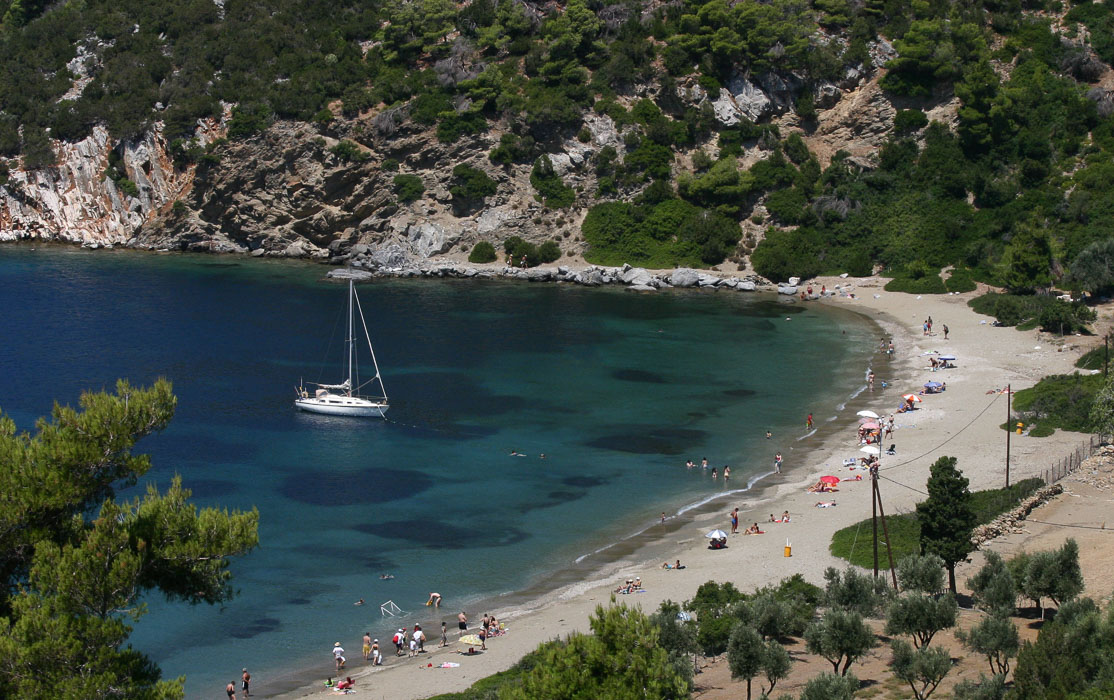
The north, which the islanders call Meroi, the calm part, is soft and wooded. Pine forest runs from the hills right down to the water, and the coast unspools into gentle, accessible beaches. Around Atsitsa and Kalogria Bay, the pines and the sea meet so gracefully that Greek law protects the landscape as a place of outstanding natural beauty.
 Then the island narrows, tilts and turns. The south is simply known as Vouni, the mountain, is rock and wind and thyme. Kochylas rises here to 792 meters, cliffs fall into sea caves, gorges cut through bare slopes, and the air smells of sage. It feels ancient. Between the two halves sits Chora, and at its top, within the castle walls, is the Monastery of Agios Georgios, which has watched over the island since the tenth century.
A landscape like this is what keeps traditions alive. An island this divided, this self-contained, this quietly remote, has always had to make its own culture, and hold on to it. And we are so glad that it did.
When the Whole Island Turns Out
Nowhere is that clearer than at Carnival. From the beginning of the Triodion and on every weekend until Clean Monday, Skyros stages one of the most unusual carnivals in Greece, and one of the oldest.
At its heart are three figures. The geros, the old man, wears the black goatskin cape, white woolen trousers and a kid-skin mask, and carries a belt of bells that can weigh as much as fifty kilos. Hauling that weight up and down the steep streets, often until well after dark, is as much an endurance feat as a dance. The korela accompanies him in white and yellow, her face veiled in the manner of a Skyrian bride, opening a path through the crowd and singing to him when he stops to rest. And then there is the frangos (or Frankos), the fool, the only one who wears ordinary Western clothes, a walking joke aimed at islanders who set aside their traditional dress. Around them all, the satirical verses of the trata poke gentle fun at whoever deserves it.
No one really seems to agree on its origin – and this doesn’t come as a surprise. Scholars swear by echoes of ancient rites, of winter being driven out and spring called in. Older islanders tell the story differently: a shepherd loses his entire flock in a brutal winter, ties on the bells of his dead animals, and walks the streets with his wife to announce the disaster. Perhaps both versions are true – and you can simply choose the one that speaks to you most. The festivities peak on Clean Monday, when the island gathers in Chora’s main square, many dressed in traditional costume, and dances to violins and lutes.
Carnival is the island’s loudest festival, but not its only one. Through the summer, Skyros lives on its panigiria, the feast-day celebrations that pull whole communities out to chapels in the hills and along the coast.
On the evening of 25 July, families climb aboard fishing boats at Molos and cross to a small islet, where a chapel to Agios Ermolaos waits at the top for a liturgy and a feast under the open sky. On 15 August, the Assumption of the Virgin (celebrated across Greece) brings a great open-air celebration that draws in nearly everyone on the island. These are quieter gatherings, but they carry the same feeling: this is a place where people still show up for one another.
The Wardrobe of an Island
Clothing on Skyros has always spoken in a local dialect. Older men wore a round black cap, a vest, baggy trousers gathered into leggings, and the thonged sandals we will come to shortly. Women wore long embroidered skirts and the famous Skyrian headscarf, yellow with a black pattern, a design so tied to the island that it was produced specially for Skyros.
Embroidery was a household art. Women spent months stitching cloths for the home, and saved the most formal ones, worked in gold thread, for special occasions. The bridal costume was the crowning piece: a heavy garment closed with a broad metal belt and marked by a strip of white fur down the front.
Skyrian brides did not traditionally marry in white. They wore the family’s old dress, or borrowed one from a neighbor, because the costumes had become too costly to make.
In the traditional Skyrian wedding, as the story goes, dozens of young girls wear the bridal costume in turn so that the groom can dance with each of them in the square, a tribute as extravagant as the clothes themselves.
You will see less of this in daily life now, though the older generation keeps the yellow scarves alive and locals still wear their folk costumes for weddings and church festivals. The best place to see it all laid out is in Chora, at the Faltaits Museum, founded in 1964 by Manos Faltaits in the family mansion, one of the first folk museums in Greece. Costumes, embroideries, pottery, woodcarving and a re-created Skyrian house sit together there, and you leave understanding that on this island clothing was never simply clothing. It was memory.
The Little Horse of Kochylas
Up in the stony south, on the slopes of Kochylas, something small and remarkable is grazing.
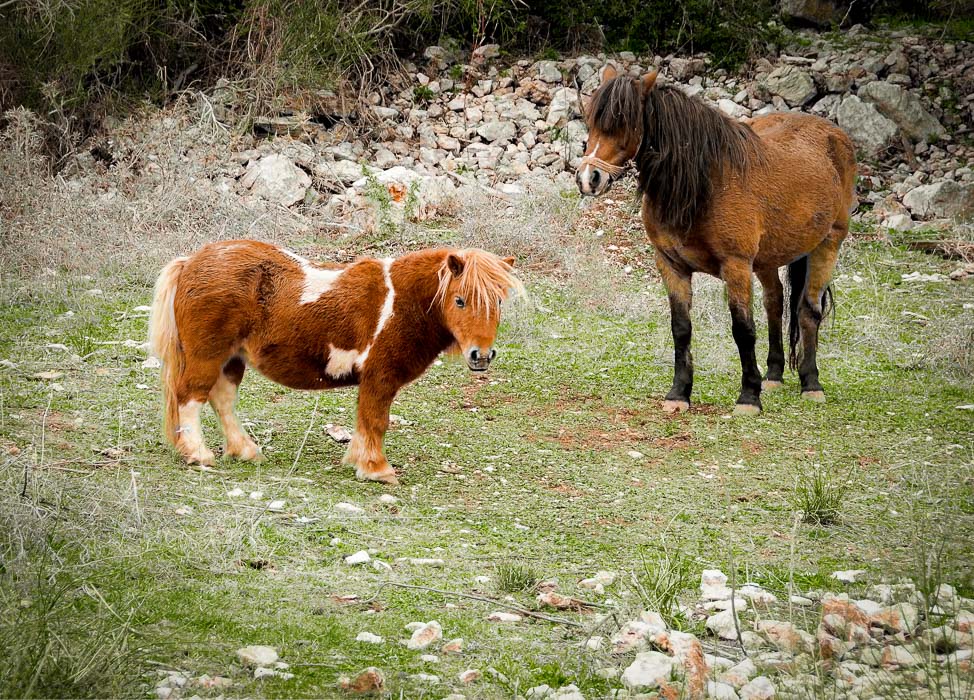
The Skyrian horse stands barely a meter high, between about 92 and 115 centimeters, with a thick mane. Its slim, strong legs and hooves are so tough they never need shoeing. It is friendly, sociable and famously intelligent, and the best part – it is one of the oldest and rarest horse breeds in Europe. Tradition connects it to a great deal of history: the horses of Achilles, Alexander the Great, and the small horses that seem to prance across the Parthenon frieze. There is no concrete proof of any of it, but standing beside one of these horses, it is easy to believe. The breed is thought to descend from horses brought to the island by Athenian settlers in the fifth century BCE, and for most of its long life it roamed semi-wild across the mountain, caught and put to work on farms when needed.
Then farming modernized. The horses were no longer needed for the fields, herds shrank, and interbreeding with feral donkeys began to dilute the breed. Today there are only a few hundred in the world, around 190 on the island itself by one recent count. Local organizations, including the Skyros Island Horse Trust, now work on breeding, conservation and welfare. To meet the horses in their own landscape, quietly and at a respectful distance, is one of the most affecting things Skyros has to offer.
Shoes That Are Made for Running
If the horse is the island’s most surprising animal, the trohadia may be its most surprising object.
These are the traditional Skyrian sandals, a lattice of leather straps woven through slots in a flat cowhide sole. In the old method, they used no nails or glue at all. The name comes from the Greek verb trecho, to run, and the design feels distinctly ancient; they look remarkably like the sandals of classical Greece. For generations, the father made them at home for his sons, and shepherds and farmers wore them through a year spent in the hills. Over time, the leather sole gave way to something more practical: a slice of old car tire, which earned the trohadia the affectionate nickname “Pirelli.”
They are a small thing, but they hold the whole island in miniature: practicality, craft, humor and a very long memory. The geros wears them beneath his bells at Carnival. Local artisans still make them, and you can find them in Chora’s market.
What To Know Before You Go
Come to Skyros without a checklist. If your schedule allows it, give it five or six days. Walk the pine forests of the north and the bare ridges of the south. Climb to the castle at dusk. Visit in the weeks before Clean Monday if you can, when the bells take over the streets, though be warned: the Carnival keeps a loose framework, and it helps to know what is happening and when. Ask a local in a café. They will tell you.