
Marble is Greece’s most enduring material. It outlasted empires, and to this day it is still being cut from the same mountains.
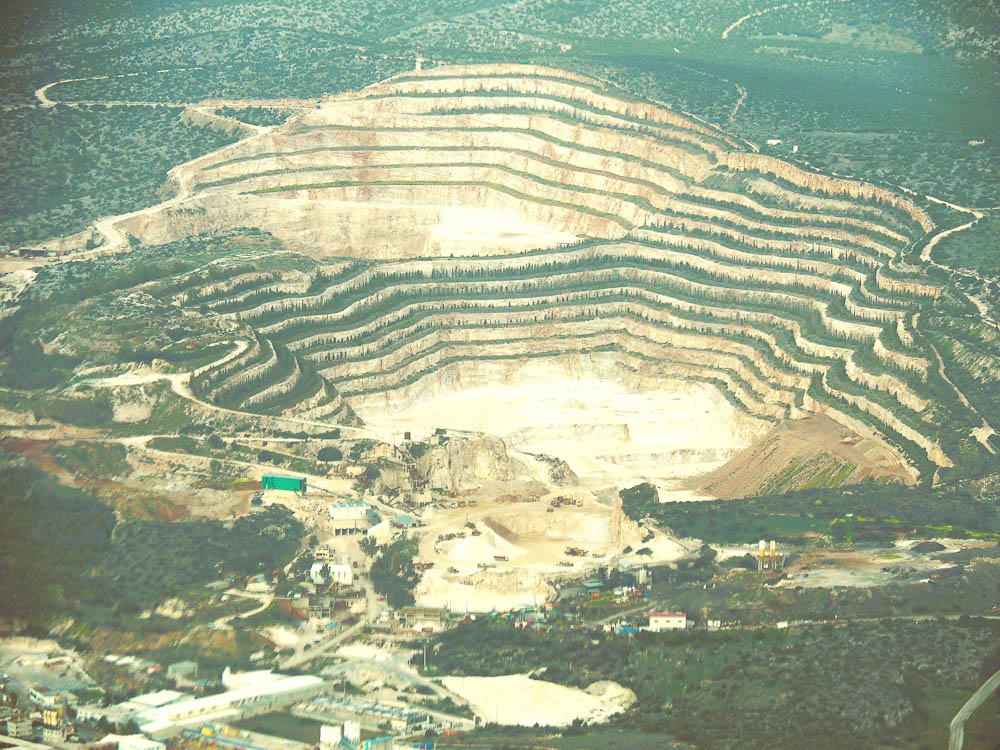
Late in the afternoon, when the sun drops low over Attica, the walls of the Dionyssos quarry on Mount Penteli warm up. The white turns to honey, then to gold; it really is a beautiful sight.
The ancient Greeks had a word for it: mármaros, meaning the shining stone. They used it to build their gods’ houses, carved their dead into it, and shipped it across the Mediterranean in vast quantities that surprise archaeologists to this day. And they did it from a handful of mountains and coastlines that you can visit today, each with its own temperament. Penteli glows. Paros is translucent. Naxos sparkles. And Tinos has a beautiful shade of green. Thassos is almost blindingly white. Drama, in the north, is where marble is a thriving industry. In fact, the broader Drama-Kavala-Thassos area accounts for 70% of Greece’s marble quarries and over 90% of the country’s primary marble production value. Let’s look at the role marble played throughout history.
Penteli: The Mountain That Became the Parthenon
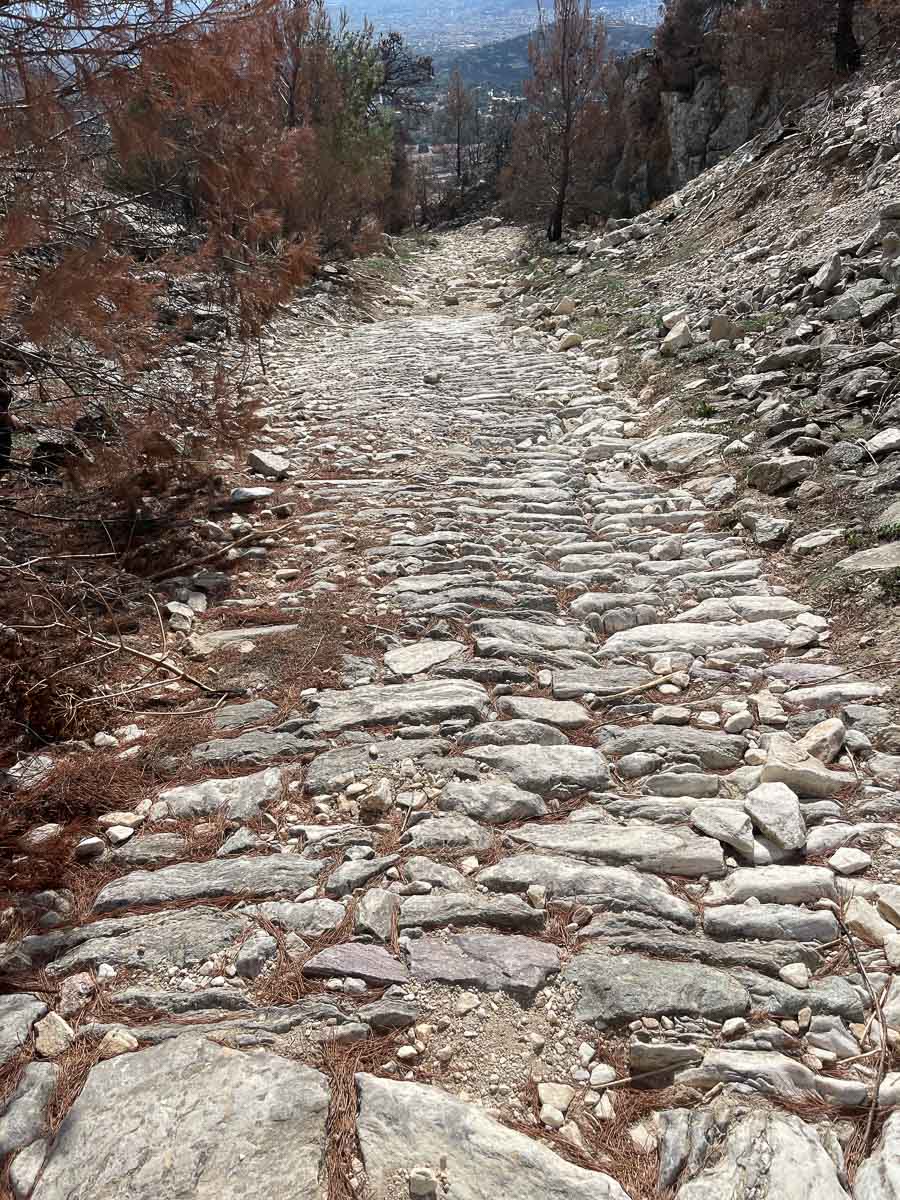
Pentelic marble is fine-grained and white with a faint yellow tint, which gives it an illuminous glow in sunlight. Over centuries, a thin film of iron oxidation deepens the color. This is why the Acropolis looks the way it does at sunset. Quarrying here dates to around the sixth century BC, but the Parthenon, begun in 447 BC, gave the mountain its name. Blocks were cut on the northern slopes and lowered to Athens along a purpose-built road that follows the natural fall of the land – a route the architect Manolis Korres traced in his book From Pentelicon to the Parthenon. Later, Herodes Atticus rebuilt the Panathenaic Stadium in the same stone (around 140–144 AD), and Rome imported it for its own monuments.
 What’s impressive is that, centuries later, the mountain has never really stopped working. Quarrying on the south-western slopes ended in 1976 for environmental reasons. However, on the north side the Dionyssomarble quarry, which reopened the ancient workings in 1877, still cuts from the same seam, and it describes itself as the source for the Acropolis restoration.
Pentelic marble has also been used in several notable projects globally, such as the Amiri Diwan (Royal Palace of Qatar), Bahai House of Worship, New Delhi, India, Sho-Hondo Temple at Mount Fuji, Japan, and, of course, the ancient temples and monuments in Athens.
Many of the quarrymen who worked Penteli over the centuries came from Paros, islanders with a gift for the stone. Climbers now use the marble walls above Dionysos, fifteen to twenty meters of pale, slippery rock, and gather there every May Day with wine and music. Nearby, the old Aloula quarry has been handed back as an Open Museum of Quarrying Art, where sculptures stand among old trees.
In April 2025, the Swedish-owned fashion brand COS transformed the quarry into a runway, staging its first-ever Athens show inside the Dionyssomarble quarry. Models descended a steel staircase through the cavern with several Hollywood guests in attendance. The brand’s designers described the space as grand yet raw and unfinished, which fit a marvelous place.
The rental income from the venue was donated to reforestation on the mountain, which was a quiet gesture and a significant one given that the slope has suffered severe fires more than once. The quarry’s own account of its events also lists Hermès, Vogue, Aimé Leon Dore with New Balance, and a techno night by Adriatique that drew thousands, evidence that the quarry has become one of Greece’s most unusual stages.
Paros: The Stone That Held Light
If Penteli is described as gold, Paros is glass. Light enters Parian marble to a depth of about 3.5 centimeters, compared with 2.5 for Carrara and just 1.5 for Pentelic, giving a sculpture a skin-like glow which the sculptors prized above everything else. The island’s finest variety is called lychnites, “lamp stone,” because the quarrymen worked by lamplight, following the vein deep into the mountain.
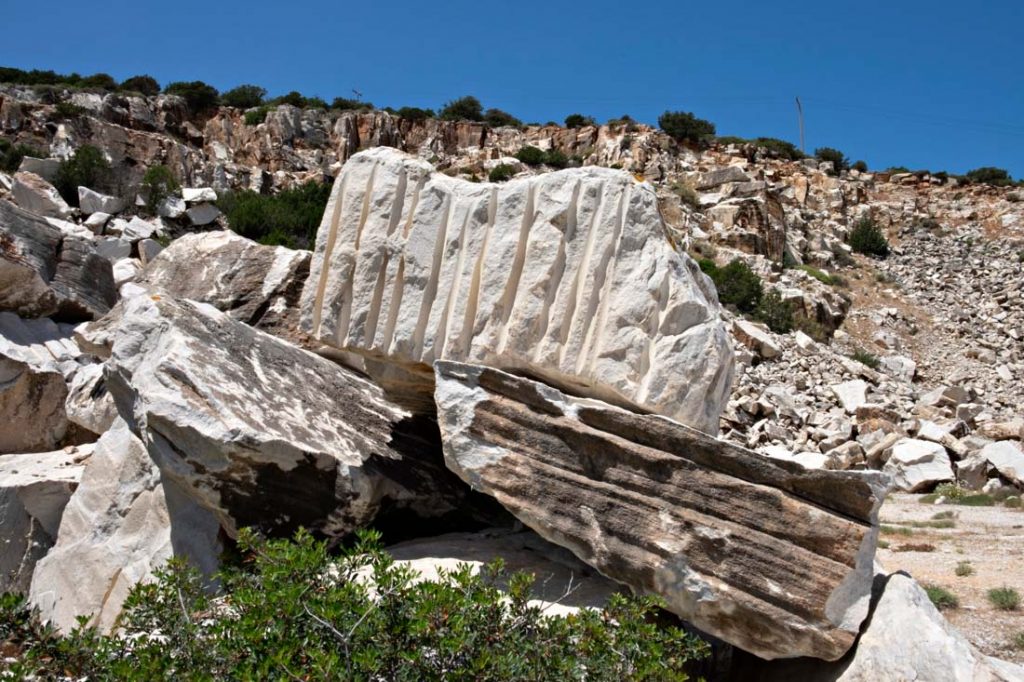
The underground quarries at Marathi, about five kilometers from Parikia (the island’s capital), were opened in the seventh century BC. However, people used Parian marble as far back as the fourth millennium BC. Walk the valley there, and you are looking at the source of the Aphrodite of Milos, the Hermes of Praxiteles, the Nike of Samothrace, the maidens of the Acropolis, and, much later, Yannoulis Chalepas’s tender Sleeping Girl. The galleries run roughly 190 meters through the mountain, and on a wall of the Quarry of the Nymphs the figures of the Olympian gods are carved, with an inscription dedicating the place to the Nymphs, dated to around 350 BC.
Paros grew rich, but then it lost the contest to the Pentelic marble, found close to Athens. It was much easier to move, and so naturally the demand drifted. Efforts to reopen Marathi in the nineteenth century came to nothing, and the galleries were left largely as the ancients abandoned them. For decades the site was left to the wind and the thistles; in 2022 local associations founded a non-profit to protect the quarries and shape them into an archaeological and cultural park, with a 3D survey of the tunnels by the National Technical University of Athens, and the first signs and stories arriving on site. It remains a gentle, unpolished place, which is its charm.
Naxos: The Giant Sculptures That Never Left
Naxos is where Greek monumental sculpture began, and where you can still see it stalled in mid-birth. In an ancient quarry near Apollonas, in the north, an enormous kouros, a young man more than ten meters long and weighing around eighty tonnes, lies on the hillside where he was cut, his feet unfinished on their plinth. Inland at Melanes, in the olive-green valley of Flerio, two more Archaic kouroi lie exactly where their makers once abandoned them, apparently when their feet broke during transport, more than twenty-five centuries ago.
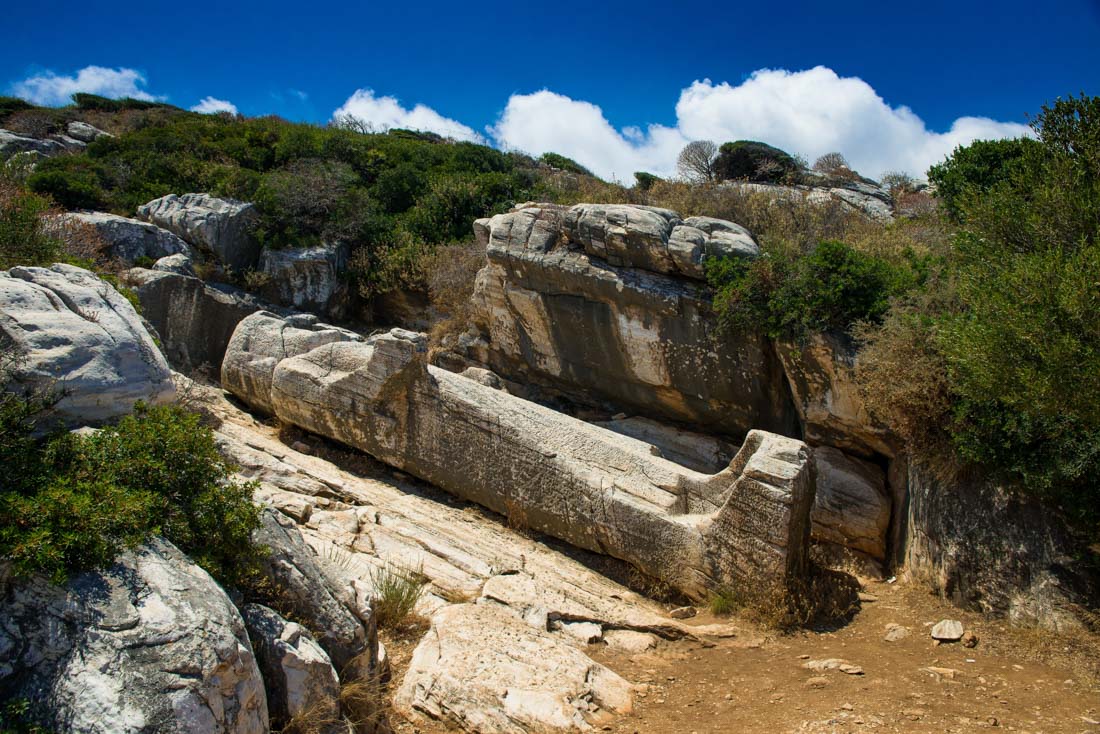
The quarry at Melanes was one of the great workshops of the Archaic world. From it came the nine-meter Colossus of the Naxians, raised on Delos, and the island’s marble also supplied the Sphinx of the Naxians at Delphi and the lions of Delos. Naxian marble is notoriously coarse-grained, the largest-crystalled marble the ancients used, and it flashes in sunlight. Those who visit the quarries near Kinidaros often remark on the glitter. Three of the five quarries there still work in small quantities. The island’s most recognizable landmark, the Portara, the great marble doorway of an unfinished Temple of Apollo, still stands against the sunset in Naxos Town.
Tinos: The Island That Carves
Tinos is the only place on this list where the stone is green. The island’s celebrated Tinos Green is not marble in the strict geological sense but a brecciated serpentinite cemented with carbonate, deep emerald with a web of white veins. Researchers have found no documented evidence that it was used in antiquity; its fame is modern. Some of the most notable projects made of Tinos Green include St. Peter’s Basilica in Vatican City, United Nations Headquarters in New York, USA, and Hagia Sophia in Istanbul, Turkey.

What the island is truly known for, though, is what it does with stone. Tinos is the home of Greek marble craftsmanship, producing sculptors such as Yannoulis Chalepas (1851–1938) and workshops that helped build nineteenth-century Athens. Half of the village of Pyrgos is an outdoor museum, with marble on its doors, fountains and tombs, and the Museum of Marble Crafts located there. It is the first of its kind in Greece, depicting a quarry and a workshop where you can follow a block’s journey from mountain to masterpiece.
In 2024, Hermès chose Tinos to celebrate its new Cut watch collection, Shapes of Time. Staging a performance directed by Alessandro Sciarroni in the abandoned Koumelas green marble quarry beside the sea. The ambiance was mesmerizing, with music bouncing off the lagoon that now fills the quarry floor, and lunch served at tables made of leftover green marble blocks. Following the event, guests joined local master sculptor Giorgos Palamaris and Hermès watch creative director Philippe Delhotal to cut marble by hand. It was the rare luxury launch that felt like a craft lesson.
Thassos: The White Edge of the Aegean
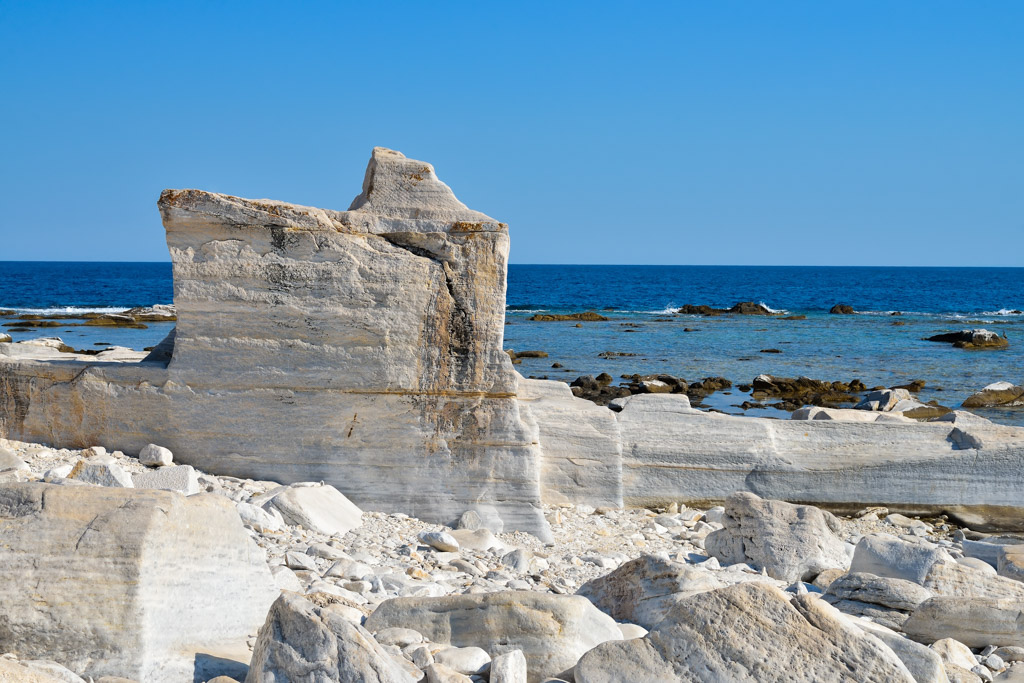
Thassos is the whitest of them all, and the ancients knew it well. At Aliki, on the south coast, marble could be loaded straight from the quarry face onto ships. The crane sockets are still visible. More than 27 quarrying sites have been identified, some with faces fifteen to twenty meters high, and the workings ran from the seventh century BC for over a thousand years. Today the quarry floor lies partly beneath clear turquoise water, and you can swim above blocks and half-finished columns abandoned by the Romans or by the early Christian builders who raised two basilicas on the headland.
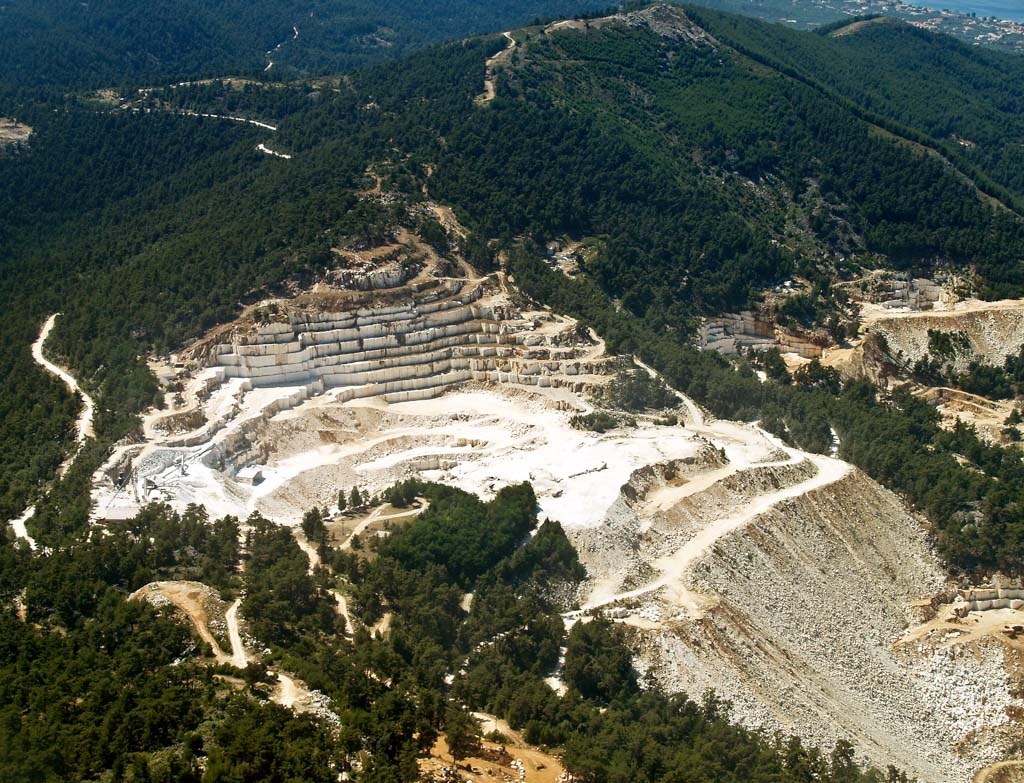
Thassian marble was distributed everywhere: to the great tomb at Amphipolis, the theatre of Thassos, the Sanctuary of the Great Gods on Samothrace, and the sarcophagi of Thessaloniki. In 2025, the IUGS added Alyki marble to its list of heritage stones. Today the island’s snow-white marble comes from active quarries in the north, in the Saliara and Vathy area. Thassian marble was also used in notable global projects such as the Masjid al-Haram in Mecca, Saudi Arabia, where it paves the way for pilgrims, and the Al-Masjid an-Nabawi (The Prophet’s Mosque), the second holiest site in Islam.
Drama: Where Marble Is a Living Industry
Drama’s marble has no ancient fame to lean on, but it has managed for itself quite well regardless. In the shadow of Mount Falakro, around the village of Volakas, a dolomitic white marble with grey veins is quarried on a scale few places in Europe can match: over a hundred licensed quarries in the wider region, open-pit and in tunnels, with blocks trucked to Thessaloniki and shipped worldwide. It is known as the “Carrara of Greece.” Until the 1980s, Volakas was a bauxite-mining area, and the story of modern Greek marble only really began in the 1960s, when building booms created the demand. The ancient theatre of Philippi is just twenty kilometers away, but Drama’s story is in the present tense.
It also has a cinematic quality. In the autumn of 2024, Romain Gavras filmed his action thriller Sacrifice, with Chris Evans and Anya Taylor-Joy, in a Volakas quarry, with platforms built into the workings for a fictional climate summit on a Greek island. The stone’s white cliffs and dramatic scale gave the film’s set what no studio could.
The Runway and the Quarry
Fashion keeps returning to Greek marble for a reason. In 2017, Karl Lagerfeld rebuilt the Parthenon and the Temple of Poseidon column by column inside the Grand Palais in Paris. In June 2021, Dior held its cruise show at the Panathenaic Stadium, the great marble horseshoe rebuilt in Pentelic stone for the first modern Olympics.
Yet the quarries themselves, as COS and Hermès discovered, offer something no set designer can: scale, silence, and the feeling of a place that was here long before the clothes and will be long after.
That is perhaps the real draw of these places. They are not ruins. They are working landscapes, sacred ones, scars and monuments at once, where the same stone that gave us the Parthenon, the Venus de Milo and a doorway on Naxos still comes out of the ground, white, gold, green, shining.