
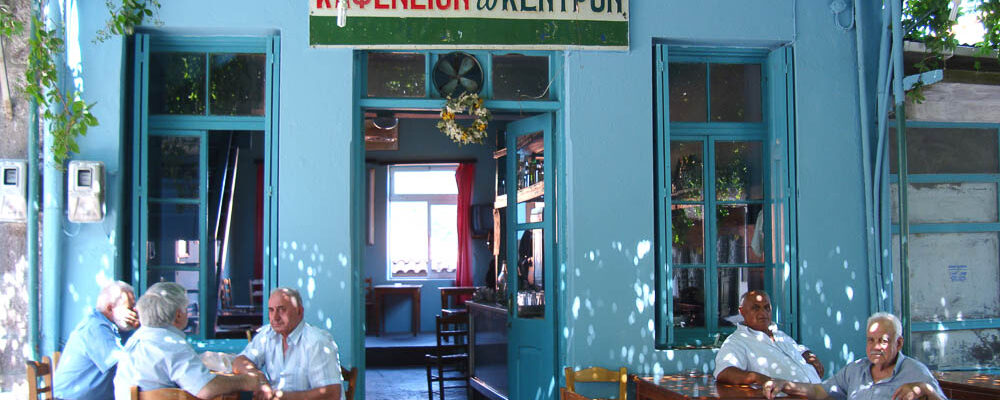
Greece has a very strong coffee culture, and anyone who visits the country will quickly fall into step with it. Coffee here isn’t something you take on the way somewhere else (although this has become popular too). It usually means that there’s a reason to be somewhere. Greeks can, quite literally, spend hours over a single cup, chatting, arguing, catching up, watching the square go by, and the invitation to “go for a coffee” (pame gia kafe) rarely means a quick one. Within a day or two, the visitor finds the pace contagious. When you start ordering the second coffee without much thought – that’s when you know that Greece has worked its magic on you. And that’s where the afternoon plan quietly disappears into this air.
Nowhere is this pastime older, or more beautifully preserved, than in the traditional kafeneio.
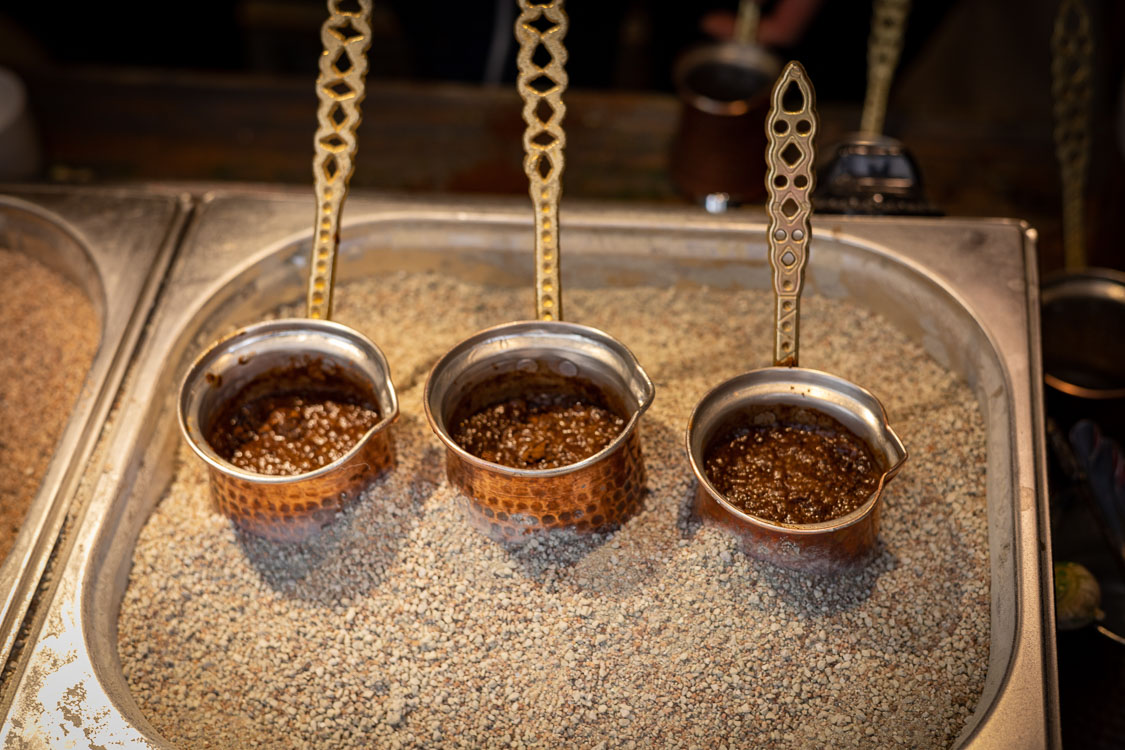
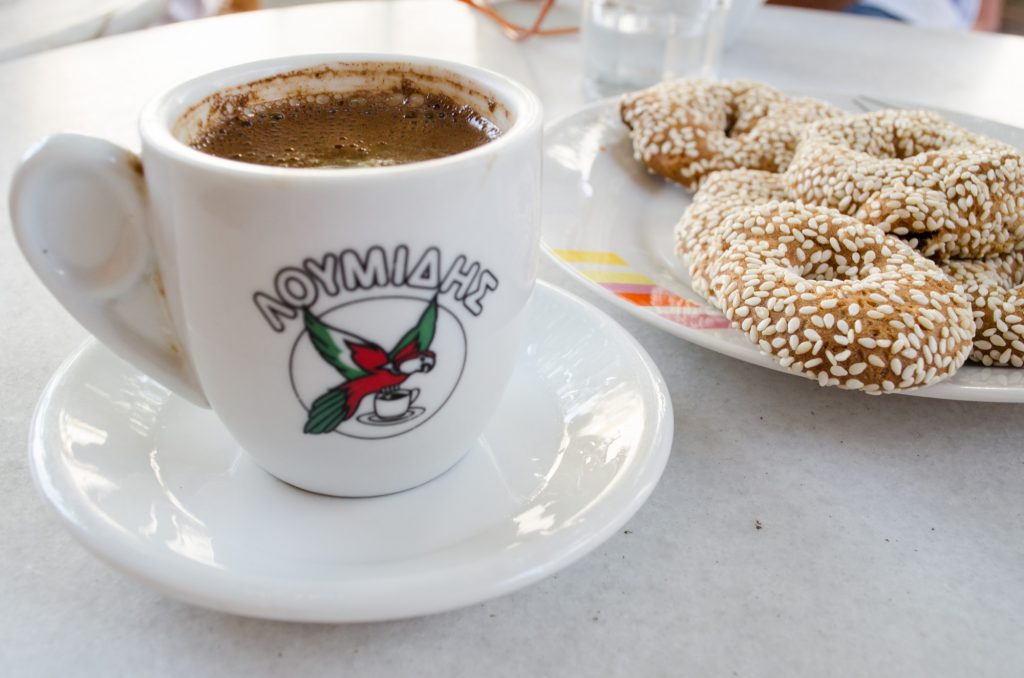
Just picture this. The sound of a chair scraping against the stone. Somewhere behind a counter, a small copper briki is lowered onto a flame, while the cafe’s owner remains alert, his eyes pinned on the briki – waiting for the foam to rise. Two men at a marble table have been discussing the same olive harvest, or the same politician, for what feels like several decades. It is no accident that they are men: for generations the kafeneio was a men’s world, the place where the village’s menfolk went to talk, play and be told the news, while the women took their own coffee at home. Nobody is in a hurry. A glass of cold water arrives beside the coffee as if it had always been there.
This is the kafeneio, the place where Greek coffee culture took root and where it still feels most itself. If you want to understand how Greeks sit with one another, argue with one another and take care of one another, you must begin here.
A Beverage Arrives and the rest is history!
The story of the kafeneia starts well beyond Greece. Coffee traveled from Arabia to Egypt, then through Persia, and into the Ottoman world in the sixteenth century. The first coffeehouse in Istanbul is generally traced to 1555, in the Tahtakale district, where two merchants from Damascus opened it. (Although some popular guides often cite a much earlier date, 1475.) Within a few generations, the kahvehane became a fixture of Ottoman towns: a place that was neither home, nor mosque, nor shop, where a man could sit, listen, trade news, and be educated simply by proximity to better-read neighbors.
Sultans were suspicious of such places, and with good reason that is. Murad IV banned them outright in 1633, and later sent spies to listen at the tables. The bans changed very little. By the early nineteenth century, Istanbul alone counted well over two thousand coffeehouses.
Greece met coffee as part of the Ottoman Empire, and it arrived from the north. In the middle of the seventeenth century the traveler Evliya Çelebi counted 348 coffeehouses in Thessaloniki, patronized chiefly by Muslims. The writer Alexandros Papadiamantis placed the spread of the habit to the rest of the country after about 1760. Athens, which was then a small town, had a handful of modest coffee places before 1821, humble things that the Revolution entirely swept away.
What came next is a very Greek transformation. In the years after independence, as Athens grew from village to capital, the kafeneio was adopted and made the nation’s own. The grandest of the early ones, Orea Hellas, at the corner of Ermou and Aiolou, became the haunt of war captains, officials and restless young men who argued about everything. When Hans Christian Andersen passed through Athens in the spring of 1841, he went to this café (he shared his experience in his travel memoir, A Poet’s Bazaar: A Journey to Greece, Turkey & Up the Danube).
Even the coffee itself went through a quiet change of identity. For much of the twentieth century it was simply “Turkish coffee” in Greek; the name “Greek coffee” took hold in earnest only after the political tensions of the 1950s and the Cyprus crisis of 1974. Specialist roasting and grinding shops, the kafekopteia, appeared from the late nineteenth century, so that the kafeneio no longer had to roast its own beans in a pan over a fire. Later came the frappé, the kafeteria, the espresso bar and the modern-day freddo espresso. The old kafeneio did not vanish, but from the 1980s onwards it began to thin out.
What Went On Inside the Kafeneio
To describe the kafeneio only as a place to drink coffee is like describing a village square as a place to stand. It was a switchboard. News of an illness, a job that needed hands, a harvest that needed a buyer: it all passed across the tables, and the news spread fast. It was where cards and tavli were played, where ouzo, raki or tsipouro arrived with a small meze as the afternoon turned to evening (most times it was earlier), where the deputy came to ask for votes.
 For a long time it was also, almost without exception, a men’s world, a fact that the women of the village understood perfectly well and managed accordingly.
It was also the door through which the wider world entered. The first telephone in a village was very often at the kafeneio. So were the first radio, the first jukebox, the first television. In some places the cinema simply arrived with its projector and hung a sheet across the room.
The Man Who Went Looking for Them
George Pittas offers the most thorough portrait of this world. Born in Athens in 1954, Pittas trained as a furniture and interior designer, studied political economy and sociology in Paris, and now lives and works on Paros, where he is also a hotelier. For years he has traveled the Aegean, writing about it. The Cafés of Greece (Ta Kafeneia tis Elladas, Koilada Lefkon, 2013) grew out of that wandering.
By his own account, his relationship with kafeneia began almost without his noticing. Whenever he arrived in a village to research something, the kafeneio was the first stop. That was where he rested, where the first scraps of information came from, and where the loneliness of the stranger slowly dissolved, as one regular after another drifted over, eager to help. In the evening he would return, worn out, to report on his day and have his directions confirmed or gently corrected, and of course the discoveries were celebrated over meze and raki. What he came to treasure most, he says, was not the research at all but the pleasure of becoming acquainted. That’s what belonging to a place felt like, even if you are merely passing by.
Athens, notably, does not appear in the book. According to Pittas, most of its finest old rooms were already gone, and the neighborhood spirit that makes a village kafeneio what it is was weaker in the capital. He also has little patience for the idea that the modern kafeteria is the kafeneio’s natural heir. It has no history, no memory, and most importantly it doesn’t show a visitor the climate and character of Greece.
Four Kafeneia Worth Visiting
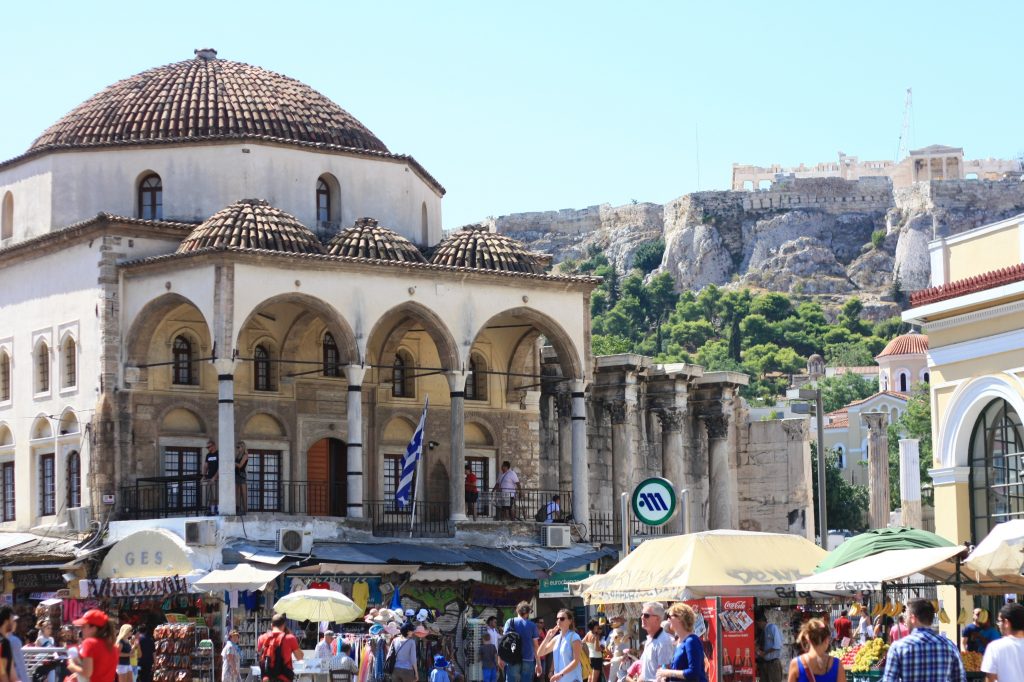 .
Orea Hellas, Athens
Tucked into the Monastiraki end of the old center, on Pandrosou at the corner of Mitropoleos, today’s Orea Hellas (founded in 1920) is a kafeneio with a century-long history, carrying the name of its celebrated nineteenth-century ancestor. The original kafeneio, as we mentioned earlier, stood elsewhere and was visited by the famous Danish author Hans Christian Andersen.
Its marble tables face Plaka and the Acropolis, and the coffee often comes with a small plate of spoon sweet. It has been entered in Greece’s National Registry of Intangible Cultural Heritage, which seems right: what is being protected is less a building than a way of sitting.
Forlida, Lafkos, Pelion
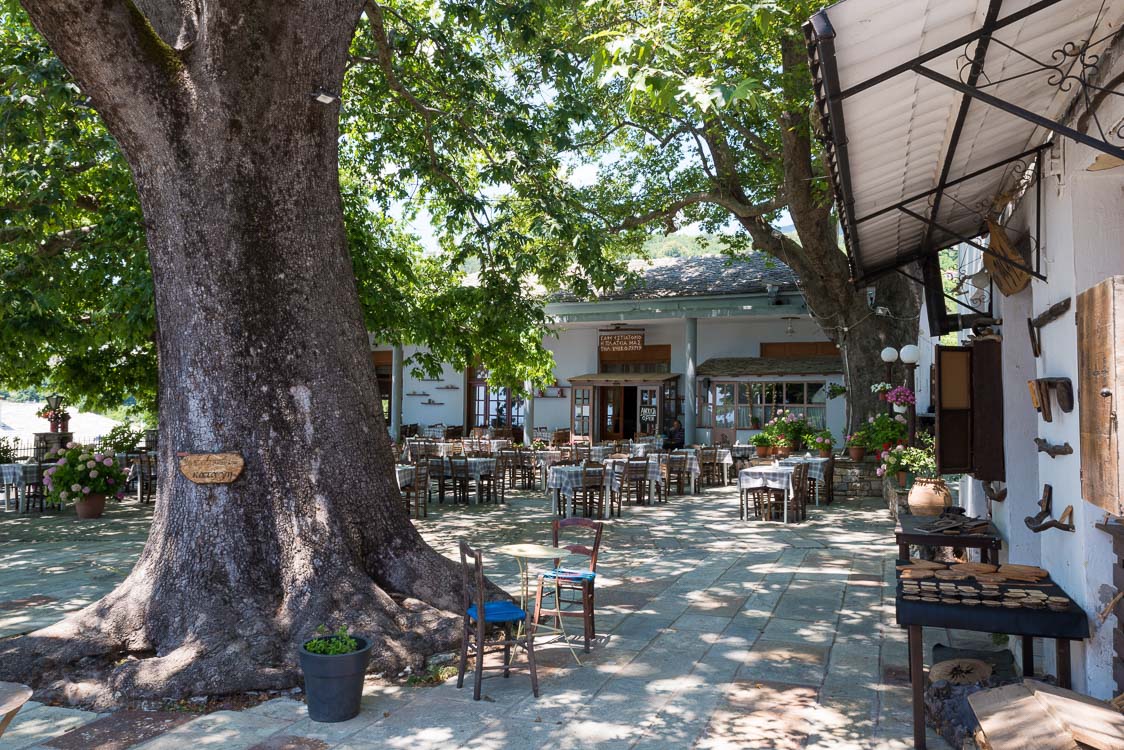
In the shade of the plane trees on the village square, the Forlida family has kept the same café open since 1785, and today Manolis Forlidas represents the seventh generation. Inside it is dark, with narrow bands of light from small windows, a floor of old cement mortar, wicker chairs, marble-topped tables and a wood stove in the middle. Upstairs there was once an inn, and at other times the same rooms were a butcher’s and a barber’s. It is among the places Pittas photographed for his book.
Akanthos, Kalarrytes, Epirus
High in the Tzoumerka mountains, in a village where visitors’ cars are not allowed, Napoleon Zagklis (a wonderful man with a big mustache) keeps the family kafeneio-grocery that his great-great-grandfather founded in 1840.
In the mid-1990s, after more than twenty years working for a multinational in Athens, Napoleon decided to come home and take it over. The shelves still hold a few grocery items, and a 1925 newspaper advertisement reminds him that his great-grandfather also ran it as a cobbler’s.
Zagklis, who also chants in the village church (and if you are lucky, he will sing for you too). Inside his kafeneio, a small room has a sofa and some chairs where visitors gather to hear him sing. And in Pittas’s book, he describes Kalarrytes as a place where time seems to stretch. In summer, the village fills with visitors and in winter the locals talk among themselves. It is a very quiet and lonely place in winter, indeed.
Karampoutze, Krousonas, Crete.
In the village of Krousonas, in the Heraklion countryside at the foothills of Mount Ida, Karampoutze takes its name from a grandfather, a blond man whom everyone called Karampoutze, kara “black” followed by mpoutzes, a word for the dark berry of the currant: a nickname that said the opposite of what the eye could see. The kafeneio, dating to 1966, serves exclusively traditional Cretan cuisine, built on seasonal produce from Cretan soil and the principles of the Cretan diet. The cooking is shaped by what the land gives that day, in a room that certainly feels more like a Cretan home than a restaurant. In Crete especially, the kafeneio and the table are close relatives.
Why Sit Down
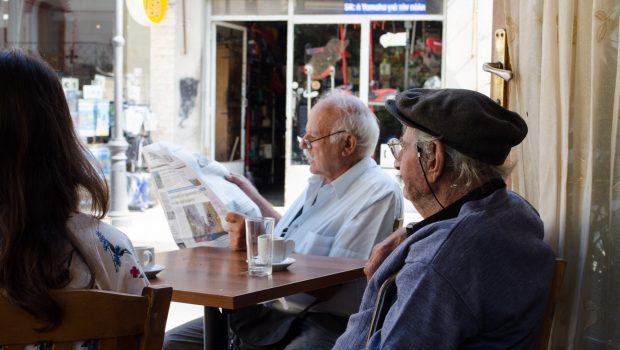 The charm of these kafeneia is that here no one will try to impress you. One important rule to remember if you do decide to visit one is to embrace the relaxed pace. Stay a little longer, have another coffee and enjoy the conversation.
Sooner or later, someone will ask where you are from and the conversation will flow from there. When the time comes for you to leave, you will most definitely know a little more about the village, and perhaps a little more about yourself.
Order the coffee metrios, medium sweet or sketo, plain. Sit by the window if there is one. And when the water arrives without being asked for, take it as what it is: the first act of Greek hospitality.